# Jane Austen — Novels, Adaptations, Community, Marketplace
> The complete novels of Jane Austen — Pride and Prejudice, Sense and Sensibility, Emma, Mansfield Park, Northanger Abbey, Persuasion — alongside biography, fan fiction, Regency resources, an Austen marketplace, and twenty-eight years of community.
## Jane Austen — Novels, Adaptations, Community, Marketplace
URL: https://jane.austen.com/
Jane Austen — Novels, Adaptations, Community, Marketplace a complete reading library Jane Austen novels · fan fiction · biography · Regency The full text of all six major novels , alongside biography, scholarship, fan-fiction archives, Regency-era resources, and a peer-to-peer marketplace gathered over twenty-eight years. A reading room and a meeting place for those who return to her sentences again and again. EST. 1997 · the original Jane Austen fan site ❦ ❦ ❦ I. 1811 Sense and Sensibility The family of Dashwood had long been settled in Sussex. Their estate was large, and their residence was at Norland Park… Begin reading II. 1813 Pride and Prejudice It is a truth universally acknowledged, that a single man in possession of a good fortune, must be in want of a wife. Begin reading III. 1814 Mansfield Park About thirty years ago Miss Maria Ward, of Huntingdon, with only seven thousand pounds, had the good luck to captivate Sir Thomas Bertram… Begin reading IV. 1815 Emma Emma Woodhouse, handsome, clever, and rich, with a comfortable home and happy disposition, seemed to unite some of the best blessings of existence… Begin reading V. 1817 Northanger Abbey No one who had ever seen Catherine Morland in her infancy would have supposed her born to be an heroine… Begin reading VI. 1817 Persuasion Sir Walter Elliot, of Kellynch Hall in Somersetshire, was a man who, for his own amusement, never took up any book but the Baronetage… Begin reading ❦ ❦ ❦ ℘ A Brief Life Biography, family, and the years 1775 to 1817. ℧ Scholarship Essays, criticism, and primary-source pointers. ❀ Regency Dress Patterns, conventions, and the cut of the period. ✿ A Reader's Guide First-time readers begin here. ❧ News & Notes New adaptations, scholarship, and society events. ⚜ The Bookshop Editions, gifts, and curiosities. ❄ Adaptations A canon of stage, screen, and audio. ⚮ The Swapfest A peer-to-peer marketplace for Austen things. conversation & correspondence Continue the discussion Three long-running conferences on the AustinSpring BBS — readers, watchers, and admirers gathering since the late 1990s. Free to read; quick to join. on austinspring.com The Austen Conference Novels, adaptations, scholarship, and the long argument about Mr. Darcy. on austinspring.com Firth & the Adaptations The 1995 BBC Pride and Prejudice and everything that came after. on austinspring.com Drool! The original screen-romance conference. Twenty-five years of leading men. There is no enjoyment like reading! How much sooner one tires of any thing than of a book! Caroline Bingley · Pride and Prejudice · ch. xi
---
## Austen.com | Jane Austen novels, fan fiction, and more
URL: https://jane.austen.com/index.htm
Austen.com | Jane Austen novels, fan fiction, and more --> The enormous popularity of Jane Austen's novels has led to many movie and television adaptions of her novels, beginning with Laurence Olivier and Greer Garson in the 1940 version of Pride and Prejudice , continuing to the nearly legendary wet shirt of Colin Firth as Mr Darcy in the 1995 BBC mini-series, and now including Bollywood musicals and zombies. In recent years, there has been an explosion of popular novels based on Jane Austen and her works. Austen.com hosts a collection of resources about the great British writer Jane Austen (1775-1817). Her novels center on the lives of young women in middle class Regency England, and every novel ends with a happy marriage or two. But don't expect simple love stories in all of Jane Austen's works. As an unmarried woman of very modest financial means, Jane Austen understood the hopes and fears of women who had to rely on marriage and family connections to provide them with a home and means to live. Miss Austen was fortunate in having the support of her family and a successful literary career, but she knew how easy it would be to become a tedious Miss Bates, a pitiable Jane Fairfax, or a sickly and forgotten Mrs Smith. With the departure of Dwiggie, a wonderful repository of fan fiction, we are now looking for new content producers who would like to help maintain this . We had 10 terrific years with the Dwiggies but they decided to move on and now we need to breathe some fresh air in to Austen.com. We're seeking an individual or group who loves Jane Austen who would like to volunteer to maintain and grow this site for love or money or both. We are also the host of firth.com , a fan site for the award winning actor who has played the role of Darcy in Jane Austen's Pride and Prejudice. Austen.com has served as the home of one of the largest communities of Jane Austen fan fiction readers and writers on the internet: the Derbyshire Writers' Guild . The message boards and stories now reside on their new home at Dwiggie.com . DWG still maintains these general Jane Austen web pages at Austen.com. --> Austen.com hosts the texts of Jane Austen's novels and lists of other resources on Jane Austen, her works , and Regency England . We also host the popular and useful Basic HTML Tag Tutorial . Time line of major events in Miss Austen's life: 16 December 1775: Jane Austen is born in Steventon, Hampshire, England to Rev. George Austen and his wife Cassandra, nee Leigh. 1783-6: Jane and her sister Cassandra attend school in Oxford, Southampton, and Reading. The remainder of her education is conducted within her family. 1787-93: Jane writes her Juvenilia, originally intended to be shared with her family and close friends. January 1796: Jane Austen mockingly writes to her sister about marrying Tom Lefroy, but the flirtation goes nowhere because of lack of money on both sides. November 1797: Jane's father offers an early version of Pride and Prejudice to a publisher, but the publisher declines to look at the manuscript. 1801: The Austen family moves to Bath, the setting of her future novels Northanger Abbey and Persuasion . 2 December 1802: Jane Austen becomes engaged to Harris Bigg-Wither, but she changes her mind the next day and breaks her engagement. Spring 1803: Jane sells Northanger Abbey to a publisher, although the publisher does not choose to publish it. January 1805: Jane's father dies, and the family's income is considerably reduced. Mrs Austen, Jane, and Cassandra must depend on the support of Jane's brothers. 1806: The Austen ladies move to Southampton. 7 July 1809: They move to Chawton in Hampshire. 30 October 1811: Sense and Sensibility is published anonymously. Only Jane Austen's close family members know she is the author. 28 January 1813: Pride and Prejudice is published, still anonymously. People outside of her family learn about her literary endeavors. 9 May 1814: Mansfield Park is published. End of December 1815: Emma is published, dedicated to the Prince Regent. August 1816: Jane finishes writing Persuasion . Early 1817: Jane begins another novel, Sandition . It will never be completed. 18 July 1817: Jane Austen dies in Winchester, most likely from Addison's disease. She is buried in Winchester Cathedral. Late 1817: Her brother Henry has Persuasion and Northanger Abbey published. The combined edition includes a "Biographical Notice of the Author" written by Henry that identifies Jane Austen as the author of her novels for the first time. Prepared by Margaret D for the Derbyshire Writers' Guild . Last update 1/11/11. Please send all comments, queries, and suggestions to Crysty (crysty.janeite@gmail.com) . --> Austen.com Site Navigation: Home | Jane Austen's Novels | Northanger Abbey | Sense and Sensibility | Pride and Prejudice | Emma | Mansfield Park | Persuasion | Lovers' Vows | | Outside links Austen.com is sponsored by
---
## Austen.com | The Works of Jane Austen
URL: https://jane.austen.com/novels.htm
Austen.com | The Works of Jane Austen Written 1798–99 · Published 1817 Northanger Abbey Jane Austen's first major novel is a comic love story set in Bath. Young Catherine Morland — an enthusiastic reader of Gothic romances — must learn to separate fantasy from reality when she visits the mysterious Northanger Abbey. Miss Austen sold the novel (then called Susan ) to a publisher in 1803, but it was never published in her lifetime. Her brother Henry published it posthumously in 1817. Read Northanger Abbey → Written ~1797 · Published 1811 Sense and Sensibility Austen's first published novel. The title page declared it written "By a Lady" — only her immediate family knew the truth. Impetuous Marianne Dashwood tumbles into a fairytale romance that goes sour, while her practical older sister Elinor copes with their family's reduced circumstances while concealing her own frustrated romantic hopes. The book was a success, earning a profit for its author. Read Sense and Sensibility → Written late 1790s · Published 1813 Pride and Prejudice Probably Austen's most-read novel, and a perennial favorite. Originally titled First Impressions , it traces the misjudgments that color the early acquaintance between the witty Elizabeth Bennet and the proud Mr Darcy — and how those impressions must be overcome before either can find happiness. The 1995 BBC adaptation starring Colin Firth brought it to a new generation of devoted readers. Read Pride and Prejudice → Written 1811–13 · Published 1814 Mansfield Park Austen's most complex and morally serious novel. Fanny Price, a poor relation taken in at the grand Mansfield Park, quietly observes the theatrics, vanity, and moral failures of those around her. During Austen's lifetime the novel was attributed only to "the Author of Sense and Sensibility and Pride and Prejudice ." The version hosted here is slightly annotated. Read Mansfield Park → Play within Mansfield Park Lovers' Vows The play the Bertrams controversially wish to perform in Mansfield Park . Includes the full text, a synopsis, a brief analysis of the novel's objections to it, and a cast list. Read Lovers' Vows → Written 1814–15 · Published 1815 Emma Self-assured Emma Woodhouse — "handsome, clever, and rich" — fancies herself a skilled matchmaker for the residents of Highbury. Her well-meaning interference leads to a series of comic misadventures and a gradual, hard-won maturation into adulthood. Dedicated to the Prince Regent (a polite command she could not refuse). Slightly annotated. Read Emma → Written 1815–16 · Published 1817 Persuasion Austen's final completed novel, written while she was suffering from the illness that would kill her. Anne Elliot, once persuaded to refuse the man she loved, is reunited with Captain Wentworth years later — both of them changed by time and circumstance. A novel of second chances, social expectation, and the constancy of true feeling. Published posthumously by her brother Henry, along with a Biographical Notice that first revealed her identity as author. Read Persuasion → Juvenilia & Unfinished Works Jane Austen's childhood writings are full of energy, humor, and very creative spelling. We do not host the texts of the Juvenilia or her unfinished works at Austen.com. The excellent Jane Austen Information Page at the Republic of Pemberley hosts e-texts of the major Juvenilia works, some of Austen's letters, biographical information, and much more.
---
## Austen.com | Offline Jane Austen Resources
URL: https://jane.austen.com/offaust.htm
Austen.com | Offline Jane Austen Resources Organizations & Societies Jane Austen Society of North America (JASNA) Brings scholars and enthusiasts together to study and celebrate Jane Austen. Publishes the literary journal Persuasions , holds annual conferences, and maintains numerous regional groups. A printable membership form is available online. Jane Austen Society (UK) Founded in 1940 to preserve Austen's cottage at Chawton. Administers the Memorial Trust that owns and maintains her house. A printable membership form is available online. Jane Austen Society of Australia (JASA) A full calendar of events including an Annual Conference, and a twice-yearly journal called Sensibilities . A printable membership form is available online. Recommended Books Biographies Jane Austen: Her Life — Park Honan (New York: St. Martin's Press, 1987.) Long considered the definitive biography of Jane Austen. Jane Austen: A Life — David Nokes (New York: Farrar, Straus, and Giroux, 1997.) Distinguished by an opening chapter on Jane Austen's flamboyant cousin Eliza Hancock and family secrets. Jane Austen: A Life — Claire Tomalin (New York: Knopf, 1997.) Focuses on each novel in turn, exploring possible autobiographical connections. Jane Austen's World Jane Austen: Real and Imagined Worlds — Oliver MacDonagh (New Haven: Yale University Press, 1991.) Examines a quarter century of English history (1792–1817) through Austen's novels. The World of Jane Austen — Nigel Nicholson (London: Weidenfeld and Nicholson, 1991.) An excellent photographic collection — pictures of family homes and buildings familiar to Austen. The Regency Period What Jane Austen Ate and Charles Dickens Knew — Daniel Pool (Touchstone Books, 1994.) A collection of fascinating facts that illuminate historical details in Austen's novels. The Writer's Guide to Everyday Life in Regency and Victorian England — Kristine Hughes (Cincinnati: Writer's Digest Books, 1998.) An excellent companion to the Pool book above. Online Bibliographies Republic of Pemberley's Bibliography A collection of Jane Austen-related books reviewed by posters to the Republic of Pemberley. Literary Companion Barbara's extensive literary companion page, also hosted on the Republic of Pemberley. Jane Austen Collection at Goucher College Baltimore's Goucher College maintains an extensive Jane Austen collection that may be visited by appointment. Tourist Sites Jane Austen Centre in Bath Located on Gay Street in Bath — the Centre provides books and leaflets on Austen's life and arranges walking tours of notable places in the city she knew so well. Jane Austen's Bath Sponsored by the Bath Tourism Bureau: information on the city of Bath as Jane Austen knew it, plus a route map for self-guided walking tours. Hampshire — Home of Jane Austen A comprehensive guide to visiting Jane Austen's home county, including Chawton and the Jane Austen House, and Winchester Cathedral where she is buried. Jane Austen's House Museum, Chawton Jane Austen spent the last eight years of her life in Chawton — a must-see for every Janeite. This was where she revised and completed her greatest novels. England's National Trust — Jane Austen Themed Visits Information on visiting stately homes featured in recent Jane Austen films and TV series. The National Trust maintains many other wonderful historical sites. North Hampshire Historical Society Published by the historical society of North Waltham, Steventon, Ashe and Deane. Includes a virtual tour of Steventon Church, where Jane Austen was baptised and worshipped for the first 25 years of her life. Jane Austen Places Beautiful photographs of the main places of Jane Austen's life: Chawton, Steventon, and Bath. Compiled by Ann Haker, updated by Margaret D. Last update 12/29/10. To suggest a link, email Crysty . See also: Jane Austen Online | Regency on the Web
---
## Austen.com | Links to Jane Austen on the Web
URL: https://jane.austen.com/onaust.htm
Austen.com | Links to Jane Austen on the Web Our Favorites The Republic of Pemberley Originally launched on Austen.com, this wide-ranging site includes the acclaimed Jane Austen Information Page — texts of the novels, letters, juvenilia, biographical and historical material, and lively discussion boards. (Site policy: they don't help with homework.) Jane Austen Fanfiction Index Victoria Cl's wonderful meta-database of Jane Austen fan fiction across many sites. Search by thematic category — "Forced/Arranged marriage," "Amnesia suffered by hero or heroine," "Vampires," and much more. Login: DWGReader / Password: Dwiggie . AustenBlog Mags blogs about Jane Austen in popular culture: news, gossip, upcoming adaptations, events, lectures, tours, and plays from around the world. Always something new, interesting, and often very funny. Texts & Discussion Janeites Discussion List An active Yahoo discussion group conducting collective reads of Austen's novels, discussing themes, adaptations, and much more. Quick and easy to register. Austen-L Archives One of the most scholarly Janeite forums on the internet — an ongoing email discussion list engaged in careful readings of the novels. Archives and subscription information available online. Molland's Beautifully presented e-texts of Jane Austen's works, illustrated with the famous C.E. and H.M. Brock illustrations. A Memoir of Jane Austen by Her Nephew The original, first biography of Jane Austen, written by James Edward Austen-Leigh in 1870. Cambridge History of English and American Literature A long scholarly section on Jane Austen. As the article states: "working rigidly within the limits of what she recognised as the proper field of her talents, she produced novels that came nearer to artistic perfection than any others in the English language." Hartfield A site dedicated to the Miramax film production of Emma — the Gwyneth Paltrow and Jeremy Northam version. Compiled by Ann Haker, updated by Margaret D. Last update 12/29/10. To suggest a link, email Crysty . See also: Off-line Jane Austen Resources | Regency on the Web
---
## Austen.com | Regency England on the Web
URL: https://jane.austen.com/onreg.htm
Austen.com | Regency England on the Web Society A Regency Repository "Of arts, literature, fashion, personalities, inventions, learning, the domestic arts, and matters military and political." If you want to know about the paintings of Constable, the invention of the bicycle, or the history of tea — here's a good place to look. When the site doesn't cover something itself, it links out to other Regency resources. The Regency Collection Covers both grand events — the major battles against Napoleon — and intimate details: individual lives, Regency-era roses. Sections on personalities, military, diarists, regency life, postal history, and industrial advances. British Titles of Nobility Not strictly a Regency site, but essential background reading. Contains thorough information on the British Peerage — rankings, forms of address, and details on the real people who have held many titles. Invaluable for understanding Austen's social hierarchy. Fashion Jessamyn's Regency Costume Companion Everything you need to make your own Regency-style dress, plus excellent background on the costumes of the period. Includes links to real costumes and period fabrics — a wonderful resource for would-be Janeites in period dress. Elizabeth Bennet's Costume List A listing — with pictures — of every costume worn by Elizabeth Bennet in the 1995 BBC/A&E production of Pride and Prejudice . Compiled right here at Austen.com. Regency Reproductions Commission your own custom-made Regency gown, or purchase patterns to make one yourself. They also hold an annual Jane Austen Festival in Australia — complete with a Regency Ball. Military & War Napoleonic Wars Series A scholarly site from the War Times Journal . Hosts archives of original documents — Wellington's and Napoleon's dispatches, letters from Admiral Lord Nelson — plus original articles, book lists, and links for further research. The Napoleon Series "An electronic magazine dedicated to Napoleon and his times." While Austen was writing, Napoleon was conquering Europe. An award-winning site sponsored by the International Napoleonic Society. Sir Arthur Wellesley, 1st Duke of Wellington Among countless Napoleon sites, few focus on the man who defeated him at Waterloo — and never lost a battle to the French army. Biographical information, accounts of battles, museums, and further links. The Historical Maritime Society A great resource for Royal Navy history — from food to fighting. The society re-enacts the world of 1805, when Britain was threatened by Bonaparte and only the Navy stood between England and invasion. Essential context for Austen's naval brothers and novels like Persuasion . Compiled by Ann Haker, updated by Margaret D. Last update 12/29/10. To suggest a link, email Crysty . See also: Jane Austen Online | Offline Jane Austen Resources
---
## Sitemap | Austen.com Jane Austen Novels, Fan Fiction & More
URL: https://jane.austen.com/sitemap.html
Sitemap | Austen.com Jane Austen Novels, Fan Fiction & More ← Home Sitemap 297 pages on austen.com Main Pages Home Home Novels Offaust Onaust Onreg Costumes (1 pages) Index Emma (56 pages) Adds Ch1 Dedicate Index Vol2Ch14 Vol1Ch10 Vol1Ch11 Vol1Ch12 Vol1Ch13 Vol1Ch14 Vol1Ch15 Vol1Ch16 Vol1Ch17 Vol1Ch18 Vol1Ch2 Vol1Ch3 Vol1Ch4 Vol1Ch5 Vol1Ch6 Vol1Ch7 ...and 36 more pages in emma/ Mans (57 pages) Index Tears Tiro2 Vol1Ch02 Vol1Ch09 Vol3Ch01 Vol1Ch01 Vol1Ch02 Vol1Ch03 Vol1Ch04 Vol1Ch05 Vol1Ch06 Vol1Ch07 Vol1Ch08 Vol1Ch09 Vol1Ch10 Vol1Ch11 Vol1Ch12 Vol1Ch13 Vol1Ch14 ...and 37 more pages in mans/ Northanger (33 pages) Index Na Complete Na Ch01 Na Ch02 Na Ch03 Na Ch04 Na Ch05 Na Ch06 Na Ch07 Na Ch08 Na Ch09 Na Ch10 Na Ch11 Na Ch12 Na Ch13 Na Ch14 Na Ch15 Na Ch16 Na Ch17 Na Ch18 ...and 13 more pages in northanger/ Persuade (27 pages) Index Prior2 Pers01 Pers02 Pers03 Pers04 Pers05 Pers06 Pers07 Pers08 Pers09 Pers10 Pers11 Pers12 Pers13 Pers14 Pers15 Pers16 Pers17 Pers18 ...and 7 more pages in persuade/ Pride (62 pages) Index Vol1Ch01 Vol1Ch02 Vol1Ch03 Vol1Ch04 Vol1Ch05 Vol1Ch06 Vol1Ch07 Vol1Ch08 Vol1Ch09 Vol1Ch10 Vol1Ch11 Vol1Ch12 Vol1Ch13 Vol1Ch14 Vol1Ch15 Vol1Ch16 Vol1Ch17 Vol1Ch18 Vol1Ch19 ...and 42 more pages in pride/ Sense (51 pages) Index Ss Ch01 Ss Ch02 Ss Ch03 Ss Ch04 Ss Ch05 Ss Ch06 Ss Ch07 Ss Ch08 Ss Ch09 Ss Ch10 Ss Ch11 Ss Ch12 Ss Ch13 Ss Ch14 Ss Ch15 Ss Ch16 Ss Ch17 Ss Ch18 Ss Ch19 ...and 31 more pages in sense/ Store (1 pages) Index Tutorial (3 pages) Advance Index Pics
---
## Videos — Austen.com
URL: https://jane.austen.com/videos.html
Videos — Austen.com Videos The latest videos about austen.com. Updated daily. Last updated: April 29, 2026 • 6 videos Pride & Prejudice by Jane Austen Full Audiobook Unabridged with Readable Text | Story Classics Story Classics • 5 years ago • 1,767,503 views A Valentine's Gift - Pride & Prejudice (1995) - FULL BOXSET | BBC Playback BBC Playback • 2 months ago • 491,016 views Mary's Best Lines | The Other Bennet Sister | BritBox BritBox • 14 hours ago • 12,891 views pride & prejudice in 60 seconds | #shorts | RomComs RomComs • 3 years ago • 2,241,081 views Awkward! #prideandprejudice #janeausten #elizabethbennet #mrdarcy #janeaustenhumor Jane Austen Runs My Life • 4 years ago • 26,193 views The chemistry between Keira Knightley and Matthew Mcfadyen ⚡️ | 🎬 Pride & Prejudice (2005) Universal Pictures • 1 year ago • 2,137,682 views ↑ Find More
---
## Emma Corrin & Jack Lowden Star in Netflix's Pride and Prejudice Teaser | Austen.com — Jane Austen
URL: https://jane.austen.com/news/2026-04-13-emma-corrin-jack-lowden-netflix-pride-and-prejudice-teaser.html
Emma Corrin & Jack Lowden Star in Netflix's Pride and Prejudice Teaser | Austen.com — Jane Austen ← Back to Austen.com — Jane Austen Emma Corrin & Jack Lowden Star in Netflix's Pride and Prejudice Teaser 2026-04-13 • Source: Jane Austen News via Google News Devoted Austenites, take a moment to compose yourselves — Netflix has gifted us with our first proper glimpse of its highly anticipated adaptation of Pride and Prejudice , and the casting alone is enough to set any sensible heart aflutter. Emma Corrin, beloved for their nuanced and emotionally rich performances, steps into the world of Longbourn alongside the immensely talented Jack Lowden, together bringing fresh life to characters readers have cherished for more than two centuries. The newly released teaser offers just enough to tantalize — a reminder that the Bennet family's comedies and heartaches remain as irresistible as ever. Jane Austen's masterwork has, of course, inspired countless stage and screen interpretations over the years, each generation finding something newly resonant in Elizabeth's sharp wit and Darcy's reluctant heart. That Netflix now turns its considerable resources toward Meryton's drawing rooms suggests the story shows no signs of relinquishing its hold on our collective imagination. We shall be watching every forthcoming development with great eagerness and, naturally, reporting back to our community of readers as further details emerge. In the meantime, seek out the teaser and allow yourself a moment of delicious anticipation — for if there is one truth universally acknowledged, it is that a fine new adaptation of Austen is always cause for celebration. Originally reported by Jane Austen News via Google News . This article was independently written and is not affiliated with the original source.
---
## Emma Corrin & Jack Lowden Star in Netflix's Pride and Prejudice Teaser | Austen.com — Jane Austen
URL: https://jane.austen.com/news/2026-04-13-emma-corrin-jack-lowden-netflix-pride-and-prejudice.html
Emma Corrin & Jack Lowden Star in Netflix's Pride and Prejudice Teaser | Austen.com — Jane Austen ← Back to Austen.com — Jane Austen Emma Corrin & Jack Lowden Star in Netflix's Pride and Prejudice Teaser 2026-04-13 • Source: Jane Austen News via Google News Austen devotees, ready your smelling salts — Netflix has offered the world its first glimpse of a brand-new adaptation of Pride and Prejudice , and it features two of Britain's most compelling young talents: Emma Corrin and Jack Lowden. The newly released teaser introduces Corrin and Lowden in what promises to be a fresh and captivating retelling of Jane Austen's most beloved novel. Corrin, celebrated for her transformative screen presence, steps into the world of Longbourn, while the quietly magnetic Lowden takes his place in what is surely Hertfordshire's most hotly contested drawing room. For those who have long cherished the sparring wit of Elizabeth Bennet and the proud reserve of Mr. Darcy, this announcement arrives like a very welcome letter on a Tuesday morning. Austen's 1813 masterpiece has proven, time and again, that no era can resist its charms — and Netflix appears determined to make this iteration worthy of the original's extraordinary legacy. Details beyond the teaser remain delightfully scarce, but anticipation among the Austen community is already running quite as high as one might expect. We shall be watching with the keenest interest and will bring you every update as this most agreeable production draws closer to its debut. Originally reported by Jane Austen News via Google News . This article was independently written and is not affiliated with the original source.
---
## Emma Corrin to Star in Netflix's New Pride and Prejudice Adaptation | Austen.com — Jane Austen
URL: https://jane.austen.com/news/2026-04-13-emma-corrin-netflix-pride-and-prejudice-adaptation.html
Emma Corrin to Star in Netflix's New Pride and Prejudice Adaptation | Austen.com — Jane Austen ← Back to Austen.com — Jane Austen Emma Corrin to Star in Netflix's New Pride and Prejudice Adaptation 2026-04-13 • Source: Jane Austen News via Google News Lovers of Longbourn, take note: Netflix is bringing a fresh vision of Jane Austen's most beloved novel to the small screen, and the casting could hardly be more intriguing. Emma Corrin — celebrated for their nuanced portrayal of Princess Diana in The Crown — has been announced as the lead in a new adaptation of Pride and Prejudice . For those of us who have long debated the relative merits of every Elizabeth Bennet to grace our screens, this announcement arrives like an express letter from Netherfield. Corrin brings a rare quality to their roles: a mixture of vulnerability and quiet defiance that seems tailor-made for a heroine who famously refuses to be easily impressed — even by a man worth ten thousand a year. Details about the production remain deliciously scarce, much like Mr. Darcy's compliments in a crowded ballroom. What we do know is that Netflix's considerable resources suggest a lavish period production, and Austen's razor-sharp social comedy feels as urgently relevant today as it did when first published in 1813. Whether you are a lifelong devotee who has worn out more than one paperback copy, or a newcomer only just discovering the wonders of Meryton society, this adaptation promises to be a compelling reason to settle into your favourite chair. We shall be watching with the keenest anticipation — and, naturally, reporting every new development as it emerges. Originally reported by Jane Austen News via Google News . This article was independently written and is not affiliated with the original source.
---
## Jane Austen's World Expands: More Adaptations Coming in 2026 | Austen.com — Jane Austen
URL: https://jane.austen.com/news/2026-04-13-jane-austen-adaptations-coming-2026.html
Jane Austen's World Expands: More Adaptations Coming in 2026 | Austen.com — Jane Austen ← Back to Austen.com — Jane Austen Jane Austen's World Expands: More Adaptations Coming in 2026 2026-04-13 • Source: Jane Austen News via Google News If the recent wave of Austen enthusiasm has left you longing for more drawing rooms, witty repartee, and romantic entanglements, take heart — 2026 promises to be a remarkably generous year for devotees of Hertfordshire's most beloved fictional family. Hot on the heels of The Other Bennet Sister — the warmly received adaptation that finally gave Mary Bennet her long-overdue moment in the spotlight — audiences can look forward to additional Jane Austen screen offerings arriving later in the year. While precise details remain close to the chest, the prospect alone is enough to set any Austen admirer's pulse quickening. It is a truth rather universally acknowledged at this point that appetite for Austen shows no sign of waning. Each new adaptation invites fresh eyes to discover her sharp social observations and enduring emotional wisdom, while offering longtime readers the particular pleasure of seeing beloved characters rendered anew. Whether you came to Austen through the 1995 BBC miniseries, a dog-eared paperback, or last year's reimaginings, the expanding calendar of productions is a welcome reminder that her stories — of love complicated by pride, circumstance, and misunderstanding — remain as irresistible as ever. We shall be watching closely and reporting back the moment further details emerge. In the meantime, there is always time for a reread. Originally reported by Jane Austen News via Google News . This article was independently written and is not affiliated with the original source.
---
## More Jane Austen Adaptations Are Coming in 2026 — Here's What We Know | Austen.com — Jane Austen
URL: https://jane.austen.com/news/2026-04-13-more-jane-austen-adaptations-coming-2026.html
More Jane Austen Adaptations Are Coming in 2026 — Here's What We Know | Austen.com — Jane Austen ← Back to Austen.com — Jane Austen More Jane Austen Adaptations Are Coming in 2026 — Here's What We Know 2026-04-13 • Source: Jane Austen News via Google News If the recent wave of Jane Austen adaptations has left you hungry for more drawing-room drama and witty repartee, you are in very good company — and 2026 promises to deliver. Fans who have already delighted in The Other Bennet Sister , the warmly received reimagining that gave bookish Mary Bennet her long-overdue moment in the spotlight, will be pleased to learn that further Austen-inspired productions are making their way to screens later this year. It appears that Hollywood — and indeed the wider entertainment world — shows no sign of tiring of Austen's sharp social comedies and enduringly romantic heroines. This is, of course, hardly surprising. Two centuries after she first set quill to paper, Jane Austen continues to feel remarkably present — her observations on love, money, and the quiet courage required to remain true to oneself speaking as clearly to modern audiences as they did to Regency readers. Whether you are a lifelong devotee who can quote Pride and Prejudice from memory, or a newcomer just discovering the pleasures of Pemberley, 2026 is shaping up to be a most agreeable year indeed. We shall, naturally, keep you fully informed as further details emerge — for here at Austen.com, anticipating a new adaptation is very nearly as enjoyable as watching one. Originally reported by Jane Austen News via Google News . This article was independently written and is not affiliated with the original source.
---
## 250 Years of Jane Austen: Why Her Voice Still Feels Like Home | Austen.com — Jane Austen
URL: https://jane.austen.com/news/2026-04-14-250-years-jane-austen-why-we-still-read-her.html
250 Years of Jane Austen: Why Her Voice Still Feels Like Home | Austen.com — Jane Austen ← Back to Austen.com — Jane Austen 250 Years of Jane Austen: Why Her Voice Still Feels Like Home 2026-04-14 • Source: Jane Austen News via Google News Two hundred and fifty years after her birth, Jane Austen remains one of the most widely read, passionately debated, and tenderly beloved novelists in the English language. That is no small achievement for a clergyman's daughter from Hampshire who published her masterworks anonymously and never lived to see her own lasting fame. As literary communities around the world pause to mark this remarkable milestone, the question being asked — why do we still return to Austen? — may be simpler to answer than it first appears. Her novels offer something that transcends period costume and country dancing: a precise, compassionate, and often wickedly funny account of what it means to be human. Elizabeth Bennet's spirited refusal to be underestimated, Anne Elliot's quiet dignity in the face of regret, Emma Woodhouse's charming and instructive capacity for self-deception — these characters do not feel like relics. They feel like people we know. Scholars, casual readers, and devoted fans alike are celebrating this anniversary through events, essays, and fresh readings of her six completed novels. Each new generation seems to discover in Austen not a museum piece but a mirror — one that reflects our own social anxieties, romantic hopes, and hunger for connection back to us with remarkable clarity. At Austen.com, we think the best way to honour 250 years of her genius is simply to keep reading, keep discussing, and keep finding ourselves somewhere between the lines. Welcome to the celebration. Originally reported by Jane Austen News via Google News . This article was independently written and is not affiliated with the original source.
---
## Emma Corrin & Jack Lowden Star in Netflix's Pride and Prejudice Teaser | Austen.com — Jane Austen
URL: https://jane.austen.com/news/2026-04-14-emma-corrin-jack-lowden-netflix-pride-and-prejudice.html
Emma Corrin & Jack Lowden Star in Netflix's Pride and Prejudice Teaser | Austen.com — Jane Austen ← Back to Austen.com — Jane Austen Emma Corrin & Jack Lowden Star in Netflix's Pride and Prejudice Teaser 2026-04-14 • Source: Jane Austen News via Google News Devotees of Longbourn, rejoice — Netflix has granted us a first glimpse at what promises to be a most anticipated adaptation of Jane Austen's beloved masterpiece. A freshly released teaser introduces Emma Corrin and Jack Lowden as the iconic Elizabeth Bennet and Mr. Darcy, and the early signs are enough to set any Austen admirer's heart aflutter. Corrin, celebrated for their nuanced and compelling screen presence, steps into the role of the spirited Elizabeth, while Lowden brings his considerable talents to bear upon the famously proud and misunderstood Darcy. It is a pairing that has already sparked considerable conversation among Austen enthusiasts, and rightly so — few literary romances demand quite so delicate a balance of wit, warmth, and barely concealed longing. Netflix continues to demonstrate a fondness for revisiting Austen's world, and this new production arrives at a moment when the novelist's insights into society, marriage, and the human heart feel as refreshingly relevant as ever. Whether you have read Pride and Prejudice a dozen times or are quite new to Meryton's social calendar, this adaptation looks set to offer something genuinely worth watching. Further details regarding a release date remain, for now, as coyly withheld as Mr. Darcy's better feelings — but we shall be watching with great anticipation and reporting every development as it emerges. Originally reported by Jane Austen News via Google News . This article was independently written and is not affiliated with the original source.
---
## Emma Corrin to Star in Netflix's New Pride and Prejudice Adaptation | Austen.com — Jane Austen
URL: https://jane.austen.com/news/2026-04-14-emma-corrin-netflix-pride-and-prejudice-adaptation.html
Emma Corrin to Star in Netflix's New Pride and Prejudice Adaptation | Austen.com — Jane Austen ← Back to Austen.com — Jane Austen Emma Corrin to Star in Netflix's New Pride and Prejudice Adaptation 2026-04-14 • Source: Jane Austen News via Google News Devotees of Longbourn and newcomers to the world of bonnets and ballrooms alike have reason to rejoice: Netflix is bringing a fresh adaptation of Jane Austen's beloved Pride and Prejudice to screens, with the luminous Emma Corrin set to lead the cast. Corrin, whose nuanced portrayals have already earned considerable admiration, steps into what may be the most celebrated role in all of English literature — the indomitable Elizabeth Bennet. It is a part that demands wit, warmth, and a talent for conveying volumes with a single raised eyebrow, qualities Corrin has demonstrated in abundance throughout their career. Details remain deliciously scarce, as one might expect from a production no doubt determined to preserve the element of surprise. Yet the announcement alone has set the Austen community abuzz with the particular excitement that only a new telling of this two-hundred-year-old story can inspire. What continues to astonish — and perhaps would have quietly amused Austen herself — is that her tale of pride, prejudice, and the slow, reluctant surrender to love remains as irresistible in the streaming age as it was on the page in 1813. Each generation discovers Pemberley anew, and makes it entirely their own. We shall be watching with great anticipation, and no small degree of impatience, for further news from Netflix's Meryton. Originally reported by Jane Austen News via Google News . This article was independently written and is not affiliated with the original source.
---
## Jane Austen's World Expands: More Adaptations Coming in 2026 | Austen.com — Jane Austen
URL: https://jane.austen.com/news/2026-04-14-jane-austen-adaptations-coming-2026.html
Jane Austen's World Expands: More Adaptations Coming in 2026 | Austen.com — Jane Austen ← Back to Austen.com — Jane Austen Jane Austen's World Expands: More Adaptations Coming in 2026 2026-04-14 • Source: Jane Austen News via Google News For those who have fallen under the spell of The Other Bennet Sister — Janice Hadlow's beloved reimagining of Mary Bennet's story — there is most agreeable news to anticipate: the calendar year 2026 promises a generous bounty of fresh Jane Austen adaptations to delight the faithful and charm the uninitiated alike. It seems the world's appetite for Austen's sharp wit, tender romance, and keenly observed social truths shows no sign of diminishing. Quite the contrary — filmmakers, television producers, and storytellers of every persuasion continue to find in her six novels an inexhaustible well of inspiration, each generation discovering anew why her characters feel so startlingly, warmly alive. Admirers of Mary Bennet's quiet journey toward self-knowledge will find themselves in fine company as further productions take their bow later in the year. Whether these new works draw directly from Austen's own pages or, like Hadlow's novel, cast a fresh light upon a familiar corner of her universe, they carry forward a tradition of creative conversation with one of literature's most enduring voices. We shall, of course, keep our readers informed as details emerge — release dates, casting, and all the agreeable particulars that make anticipation itself a pleasure. In the meantime, there is nothing to prevent a most satisfying reread of Pride and Prejudice , should you find the wait rather too much to bear with composure. Originally reported by Jane Austen News via Google News . This article was independently written and is not affiliated with the original source.
---
## A Swoon-Worthy New Period Drama Is Winning Over Austen Lovers | Austen.com — Jane Austen
URL: https://jane.austen.com/news/2026-04-14-swoon-worthy-period-drama-winning-over-austen-lovers.html
A Swoon-Worthy New Period Drama Is Winning Over Austen Lovers | Austen.com — Jane Austen ← Back to Austen.com — Jane Austen A Swoon-Worthy New Period Drama Is Winning Over Austen Lovers 2026-04-14 • Source: Jane Austen News via Google News If your heart has been quietly longing for a fresh dose of drawing-room tension, witty repartee, and the delicious ache of almost-love, it appears the television gods have heard your prayers. A newly celebrated period drama inspired by Jane Austen's world is earning rapturous praise from critics and viewers alike, with one prominent reviewer declaring it the finest offering of its kind in recent memory. For those of us who find ourselves returning again and again to Pemberley, Hartfield, and Kellynch Hall, the news that a contemporary production has captured something of that ineffable Austen spirit is genuinely exciting. It speaks to how remarkably alive her sensibility remains — her sharp observations on society, her deeply human characters, and her unwavering belief that intelligence and feeling are not at odds. Whether you are a lifelong devotee who can quote Pride and Prejudice from memory, or a curious newcomer just beginning to discover what all the fuss is about, a production that earns such warm admiration deserves a place on your watchlist. Jane Austen had a rare gift for making readers feel deeply seen, and the best adaptations carry that gift forward into a new era. We shall be watching closely — and, in true Austen fashion, forming our own opinions with great enthusiasm. Originally reported by Jane Austen News via Google News . This article was independently written and is not affiliated with the original source.
---
## More Jane Austen Adaptations Are Coming in 2026 — Here's What We Know | Austen.com — Jane Austen
URL: https://jane.austen.com/news/2026-04-15-more-jane-austen-adaptations-coming-2026.html
More Jane Austen Adaptations Are Coming in 2026 — Here's What We Know | Austen.com — Jane Austen ← Back to Austen.com — Jane Austen More Jane Austen Adaptations Are Coming in 2026 — Here's What We Know 2026-04-15 • Source: Jane Austen News via Google News For those who have already fallen in love with The Other Bennet Sister — Janice Hadlow's tender reimagining of plain, bookish Mary Bennet — there is delightful news to anticipate: the Austen adaptation universe shows no sign of slowing down as 2026 unfolds. It seems the appetite for bringing Austen's beloved characters and stories to new audiences remains as robust as ever, with further screen and stage interpretations reportedly in the pipeline for later this year. Whether these projects revisit familiar drawing rooms or dare to venture beyond the pages of the original novels, Austen devotees will find themselves well entertained. There is something wonderfully fitting about this moment. Two centuries after Miss Austen first introduced us to the Bennet household at Longbourn, artists and storytellers are still finding fresh perspectives within her work — proof, if any were needed, that her characters possess a vitality that no amount of time can diminish. We will be watching closely as details emerge and promise to keep our readers fully informed. In the meantime, if you have not yet made Mary Bennet's acquaintance through Hadlow's novel, consider this your most cordial invitation to do so before the next wave of Austen entertainment arrives. Originally reported by Jane Austen News via Google News . This article was independently written and is not affiliated with the original source.
---
## Netflix Is Bringing Pride and Prejudice to a New Generation | Austen.com — Jane Austen
URL: https://jane.austen.com/news/2026-04-15-netflix-pride-and-prejudice-adaptation-what-we-know.html
Netflix Is Bringing Pride and Prejudice to a New Generation | Austen.com — Jane Austen ← Back to Austen.com — Jane Austen Netflix Is Bringing Pride and Prejudice to a New Generation 2026-04-15 • Source: Jane Austen News via Google News It is a truth universally acknowledged that every generation deserves its own Pride and Prejudice — and Netflix appears ready to oblige. The streaming giant is developing a fresh adaptation of Jane Austen's beloved 1813 novel, and anticipation among Austen devotees is already running delightfully high. While full details remain closer-held than Mr. Darcy's feelings at a country dance, what has emerged paints a picture of a production with genuine ambition. Netflix is clearly aware of the formidable legacy it is stepping into — one that includes the iconic 1995 BBC miniseries and the warmly received 2005 film starring Keira Knightley — and seems determined to offer something worthy of Austen's sparkling wit and timeless insight into the human heart. For readers who have long cherished the story of Elizabeth Bennet and her five sisters navigating love, money, and the merciless opinions of their neighbours, a new adaptation is always cause for both excitement and a certain nervous anticipation. Will this Darcy capture that irresistible blend of pride and vulnerability? Will Elizabeth's quick intelligence and moral courage shine through? We shall be watching with great interest as further details emerge. In the meantime, perhaps it is the perfect moment to revisit the novel itself — because no adaptation, however splendid, quite matches the pleasure of Austen's own prose. Originally reported by Jane Austen News via Google News . This article was independently written and is not affiliated with the original source.
---
## A Fresh Pride and Prejudice Is Coming — and We Are All Anticipation | Austen.com — Jane Austen
URL: https://jane.austen.com/news/2026-04-15-new-pride-and-prejudice-adaptation-announced.html
A Fresh Pride and Prejudice Is Coming — and We Are All Anticipation | Austen.com — Jane Austen ← Back to Austen.com — Jane Austen A Fresh Pride and Prejudice Is Coming — and We Are All Anticipation 2026-04-15 • Source: Jane Austen News via Google News It is a truth universally acknowledged that every generation must have its own Pride and Prejudice — and the latest news suggests ours is very much on its way. A brand-new adaptation of Jane Austen's best-loved novel is in development, inviting yet another wave of audiences to fall under the spell of Elizabeth Bennet and Mr. Darcy for the very first time. Details remain deliciously scarce, much like Darcy himself at the Netherfield ball, but the mere announcement has set the Austen world abuzz. Each retelling brings something distinct to the source material — a new setting, a fresh sensibility, a reimagined lens through which Austen's sharp wit and profound emotional intelligence can shine anew. What makes Pride and Prejudice so remarkably adaptable is precisely what makes it immortal: its characters feel urgently, achingly human. Pride, prejudice, misunderstanding, and the slow, wonderful work of truly knowing another person — these are not Regency concerns. They are simply human ones. Whether you first encountered Elizabeth Bennet on the page, through Colin Firth's famous lake scene, or via Keira Knightley striding across a misty English dawn, the prospect of a new interpretation is cause for quiet excitement. We shall be watching developments with great interest — and perhaps a little of that breathless impatience Miss Bennet herself would have understood entirely. Originally reported by Jane Austen News via Google News . This article was independently written and is not affiliated with the original source.
---
## Daisy Edgar-Jones Steps Into Austen's World in Sense & Sensibility Trailer | Austen.com — Jane Austen
URL: https://jane.austen.com/news/2026-04-16-daisy-edgar-jones-sense-and-sensibility-trailer-2024.html
Daisy Edgar-Jones Steps Into Austen's World in Sense & Sensibility Trailer | Austen.com — Jane Austen ← Back to Austen.com — Jane Austen Daisy Edgar-Jones Steps Into Austen's World in Sense & Sensibility Trailer 2026-04-16 • Source: Jane Austen News via Google News The first glimpse of a brand-new adaptation of Sense and Sensibility has arrived, and it is already setting hearts aflutter across the Austen community. The newly released trailer introduces Daisy Edgar-Jones — beloved for her captivating performances in Normal People and Fresh — as she steps gracefully into the role of one of Jane Austen's most enduring heroines. For those who treasure the delicate balance Austen struck between romantic longing and rational restraint, this adaptation promises to honor that spirit anew. Edgar-Jones brings a luminous sensitivity to the role that feels entirely in keeping with the novel's emotional depth, suggesting audiences are in for a portrayal that is both faithful to Austen's vision and refreshingly alive for a modern era. Few novels have captured the tension between feeling and reason quite so beautifully as Sense and Sensibility , Austen's debut, published in 1811. Its themes — the perils of impulsivity, the quiet courage of practicality, the extraordinary pain of loving unwisely — resonate as powerfully today as they did in Regency drawing rooms. With each new adaptation, a fresh generation discovers what devoted readers have always known: Austen's world is never truly past. We shall be watching this one with great anticipation indeed. Originally reported by Jane Austen News via Google News . This article was independently written and is not affiliated with the original source.
---
## First Look: New Sense & Sensibility Adaptation Wows Early Viewers | Austen.com — Jane Austen
URL: https://jane.austen.com/news/2026-04-16-new-sense-and-sensibility-adaptation-first-footage-2025.html
First Look: New Sense & Sensibility Adaptation Wows Early Viewers | Austen.com — Jane Austen ← Back to Austen.com — Jane Austen First Look: New Sense & Sensibility Adaptation Wows Early Viewers 2026-04-16 • Source: Jane Austen News via Google News Could a new adaptation of Sense and Sensibility be poised to claim a place among the finest Jane Austen films ever made? If the earliest glimpses of footage are any indication, devoted fans of Elinor and Marianne Dashwood may have very much to anticipate indeed. Fresh preview material from the upcoming production has generated considerable excitement across the Austen community, with many observers noting that the film appears to capture both the emotional richness and the sharp social wit that make the novel so enduringly beloved. Austen's meditation on reason versus feeling — and the quiet heroism of bearing heartbreak with dignity — seems to have found a sympathetic creative team willing to honour its nuances. Sense and Sensibility has, of course, been beautifully served on screen before. Ang Lee's 1995 masterpiece, with Emma Thompson's luminous screenplay, set a formidably high bar. Yet every generation deserves its own encounter with the Dashwood sisters, and the promise of a fresh interpretation is cause for genuine delight rather than apprehension. We shall be watching closely as more details emerge. In the meantime, consider this your gentle reminder to revisit the novel itself — because no adaptation, however splendid, quite replaces the pleasure of Austen's own incomparable prose. Originally reported by Jane Austen News via Google News . This article was independently written and is not affiliated with the original source.
---
## First Look: New Sense & Sensibility Film Is Already Turning Heads | Austen.com — Jane Austen
URL: https://jane.austen.com/news/2026-04-16-new-sense-and-sensibility-adaptation-first-footage.html
First Look: New Sense & Sensibility Film Is Already Turning Heads | Austen.com — Jane Austen ← Back to Austen.com — Jane Austen First Look: New Sense & Sensibility Film Is Already Turning Heads 2026-04-16 • Source: Jane Austen News via Google News Devotees of Jane Austen's beloved second novel have reason to feel rather like Marianne Dashwood discovering a new piece of music — thrilled, breathless, and entirely unable to contain themselves. Early footage from an upcoming adaptation of Sense and Sensibility has begun circulating, and the response from fans and critics alike has been nothing short of rapturous. The preview glimpses suggest a production that honors Austen's sharp wit and emotional depth while bringing something genuinely fresh to the screen. For those who hold the 1995 Emma Thompson and Ang Lee version close to their hearts, or who treasure the quieter 2008 BBC miniseries, the bar is undeniably high — and yet early impressions indicate this new telling may be ready to claim its own distinguished place in the Austen adaptation canon. What is it about Elinor and Marianne's story that continues to resonate across every generation? Perhaps it is the timeless tension between feeling and restraint, between what we long to express and what propriety — or simply self-preservation — urges us to keep silent. Austen understood that conflict intimately, and audiences never seem to tire of watching it played out. We at Austen.com will be keeping a very close eye on further developments, and we invite you to share your hopes and expectations in the comments below. Could this be the Sense and Sensibility adaptation we have all been waiting for? The evidence, so far, is most encouraging. Originally reported by Jane Austen News via Google News . This article was independently written and is not affiliated with the original source.
---
## /emma/adds.htm
URL: https://jane.austen.com/emma/adds.htm
Kali's Emma Page The most comprehensive page on Emma was prepared by Kali of the Republic of Pemberley , and is housed on their computers. This is updated regularly and contains opinions on the novel, character descriptions, information on such things as the movie adaptations, published sequels, and Emma fan fiction. Letters Relating to the Dedication of Emma Jane Austen E-texts, Etc. has the letters which were exchanged between the Librarian to HRH The Prince Regent and Miss Austen regarding the dedication of Emma to the Prince. Opinions of Emma & Letters about Emma Jane Austen E-texts, Etc. also has a collection of the opinions of Miss Austen's acquaintance upon reading Emma and a number of other letters written by Miss Austen, her brother and others which pertain to this novel. Penguin Classics' Emma Page This page has excerpts from some essays on Emma and Jane Austen. If you have more links to add, e-mail to: suggestions@austen.com
---
## Advanced HTML Stuff
URL: https://jane.austen.com/tutorial/advance.htm
Advanced HTML Stuff This page is to help someone who wishes to create, in its entirety, an HTML document. It also contains some tags that one might find useful when creating a new page. Additional Tags one needs for an HTML Document Meaning of These Tags Putting in Line Breaks and Paragraphs Centering Text Making an Image Also Be a Link Making Text Appear Exactly As Typed How to Make Tables How to make Imagemaps Additional Tags For An HTML Document Apart from what you can learn from the Basic HTML Tags Tutorial , the only additional tags that a person absolutely needs to write an HTML page are the following: At the very top of the page you need: Put page title here At the very bottom of the page you need: Meaning Of These Tags The " html " tag tells the browser to look for the various tags, and tells it that it is not dealing with a plain-text page. I don't really know why there are " head " and " body " tags, but there are, so one must use them. The " title " tag tells the browser what to put in the bar at the very, very top of the screen. On my machine this is the blue bar that says something like "Netscape--[Advanced HTML Stuff]". It is the "Advanced HTML Stuff" that is the title of the page; the Netscape portion of that title will appear regardless of what you put as your title. In the top " body " tag, you can put in your font color and background information. If you want to use a particular background color, like a pale pink, you use a tag like: Different people can set their default background color to different things. If you want it to appear white for everyone, you must define the bgcolor="#ffffff". If you want to use a graphic (.jpg or .gif) as your background (it will be tiled across the screen) use a tag like: If you want all of the text of the page to appear blue you would use the body tag: If you want the unfollowed links to be a certain color, like green, then use the tag: If you want the followed links to be a certain color, like red, then use the tag: All of these can be combined into one (except the background tags which are mutually exclusive): or Putting In Line Breaks And Paragraphs You also need to put in all of the end of line breaks by hand with:
And all of the paragraph breaks by hand with: Without these two, the text will appear in one large block, without any paragraph breaks.
will cause the text to begin directly below the previous line, and
will leave a blank line between the sections of text. Example: "The respect created by the conviction of his valuable qualities, though at first unwillingly admitted, had for some time ceased to be repugnant to her feeling; and it was now heightened into somewhat a friendlier nature, by the testimony so highly in his favor,
and bringing forward his disposition in so amiable a light, which yesterday had produced. But above all, above respect and esteem, there was a motive within her of goodwill which could not be overlooked. It was gratitude; gratitude, not merely for having once loved her, but for living her still well enough to forgive all the petulance and acrimony of her manner in rejecting him,
and all the unjust accusations accompanying her rejection. He who, she had been persuaded, would avoid her as his greatest enemy, seemed, on this accidental meeting, most eager to preserve the acquaintance, and without any indelicate display of regard, or any peculiarity of manner, where their two selves only were concerned, was soliciting the good opinion of her friends, and bent on making her known to his sister." Centering Text To center things on the screen, (this will work for everything between the tags: text, images, tables, etc.)
Text or picture Making an Image Also Be A Link You can make a picture also be a link to a web site by combining the links for each. The link tag (a href=) goes around the outside, with the image tag (img src=) taking the place of the words of the link: 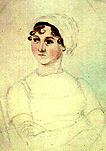 Result: Or, with text too: Jane Austen Information Page Result: Jane Austen Information Page You can also remove the border around the image, by adding border=0 to the inside of the image tag: Jane Austen Information Page Result: Jane Austen Information Page Making Text Appear Exactly As Typed If you want the text to appear exactly as you type it, use these tags:
 text
This will use what is known as a "fixed-width font". This means that every character will be exactly as wide as every other character. This is useful if you are trying to line up text on different lines. But you must put in the end-of-line breaks yourself--you do not have to use the
or tags to do this, just hit "Return"/"Enter" at the end of the line. How To Create A Table Sometimes it is hard to get things to appear exactly where you want them on a page without creating a table. The table allows you to line things up in ways that you can not do with regular tags. This is especially true with pictures. Without a table the text will tend to wrap around a graphic, but a table will keep things in better alignment. In addition you may simply want to organise your page using tables, either way the tags for a table are:
-- Starts the table -- Starts each row | -- Starts each cell | -- Ends each cell
-- Ends each row
-- Ends the table. Example: | Row 1-Cell 1 | Row 1-Cell 2 | Row 1-Cell 3 | Row 1-Cell 4 |
| Row 2-Cell 1 | Row 2-Cell 2 | Row 2-Cell 3 | Row 2-Cell 4 |
| Row 3-Cell 1 | Row 3-Cell 2 | Row 3-Cell 3 | Row 3-Cell 4 |
Result: Row 1-Cell 1 Row 1-Cell 2 Row 1-Cell 3 Row 1-Cell 4 Row 2-Cell 1 Row 2-Cell 2 Row 2-Cell 3 Row 2-Cell 4 Row 3-Cell 1 Row 3-Cell 2 Row 3-Cell 3 Row 3-Cell 4 You can then add a border to the table to divide up the cells by adding the word "border" to the table tag: Result: Row 1-Cell 1 Row 1-Cell 2 Row 1-Cell 3 Row 1-Cell 4 Row 2-Cell 1 Row 2-Cell 2 Row 2-Cell 3 Row 2-Cell 4 Row 3-Cell 1 Row 3-Cell 2 Row 3-Cell 3 Row 3-Cell 4 By specifying how wide you want your border to be, you can create some nifty borders. Here is what you can do by specifying the border width (in pixels) as 5 or as 30: Result: Row 1-Cell 1 Row 1-Cell 2 Row 1-Cell 3 Row 1-Cell 4 Row 2-Cell 1 Row 2-Cell 2 Row 2-Cell 3 Row 2-Cell 4 Row 3-Cell 1 Row 3-Cell 2 Row 3-Cell 3 Row 3-Cell 4 Result: Row 1-Cell 1 Row 1-Cell 2 Row 1-Cell 3 Row 1-Cell 4 Row 2-Cell 1 Row 2-Cell 2 Row 2-Cell 3 Row 2-Cell 4 Row 3-Cell 1 Row 3-Cell 2 Row 3-Cell 3 Row 3-Cell 4 Here is an example of the problem of pictures and text: Without a table: "The respect created by the conviction of his valuable qualities, though at first unwillingly admitted, had for some time ceased to be repugnant to her feeling; and it was now heightened into somewhat a friendlier nature, by the testimony so highly in his favor, and bringing forward his disposition in so amiable a light, which yesterday had produced. But above all, above respect and esteem, there was a motive within her of goodwill which could not be overlooked. It was gratitude; gratitude, not merely for having once loved her, but for living her still well enough to forgive all the petulance and acrimony of her manner in rejecting him, and all the unjust accusations accompanying her rejection. He who, she had been persuaded, would avoid her as his greatest enemy, seemed, on this accidental meeting, most eager to preserve the acquaintance, and without any indelicate display of regard, or any peculiarity of manner, where their two selves only were concerned, was soliciting the good opinion of her friends, and bent on making her known to his sister." With a table: "The respect created by the conviction of his valuable qualities, though at first unwillingly admitted, had for some time ceased to be repugnant to her feeling; and it was now heightened into somewhat a friendlier nature, by the testimony so highly in his favor, and bringing forward his disposition in so amiable a light, which yesterday had produced. But above all, above respect and esteem, there was a motive within her of goodwill which could not be overlooked. It was gratitude; gratitude, not merely for having once loved her, but for living her still well enough to forgive all the petulance and acrimony of her manner in rejecting him, and all the unjust accusations accompanying her rejection. He who, she had been persuaded, would avoid her as his greatest enemy, seemed, on this accidental meeting, most eager to preserve the acquaintance, and without any indelicate display of regard, or any peculiarity of manner, where their two selves only were concerned, was soliciting the good opinion of her friends, and bent on making her known to his sister." How To Create An Image Map An image map is a single graphic which, when you point at different parts of the picture, will link you to different pages. Here is a description on how to make image maps: How to make Imagemaps Ann Haker 01/10/00 © 1998, 1999, 2000 Copyright held by Ann Haker.
---
## /emma/ch1.htm
URL: https://jane.austen.com/emma/ch1.htm
Emma Woodhouse, handsome, clever, and rich, with a comfortable home and happy disposition, seemed to unite some of the best blessings of existence; and had lived nearly twenty-one years in the world with very little to distress or vex her. She was the youngest of the two daughters of a most affectionate, indulgent father, and had, in consequence of her sister's marriage, been mistress of his house from a very early period. Her mother had died too long ago for her to have more than an indistinct remembrance of her caresses, and her place had been supplied by an excellent woman as governess, who had fallen little short of a mother in affection. Sixteen years had Miss Taylor been in Mr. Woodhouse's family, less as a governess than a friend, very fond of both daughters, but particularly of Emma. Between them it was more the intimacy of sisters. Even before Miss Taylor had ceased to hold the nominal office of governess, the mildness of her temper had hardly allowed her to impose any restraint; and the shadow of authority being now long passed away, they had been living together as friend and friend very mutually attached, and Emma doing just what she liked; highly esteeming Miss Taylor's judgment, but directed chiefly by her own. The real evils indeed of Emma's situation were the power of having rather too much her own way, and a disposition to think a little too well of herself; these were the disadvantages which threatened alloy to her many enjoyments. The danger, however, was at present so unperceived, that they did not by any means rank as misfortunes with her. Sorrow came—a gentle sorrow—but not at all in the shape of any disagreeable consciousness.—Miss Taylor married. It was Miss Taylor's loss which first brought grief. It was on the wedding-day of this beloved friend that Emma first sat in mournful thought of any continuance. The wedding over and the bride-people gone, her father and herself were left to dine together, with no prospect of a third to cheer a long evening. Her father composed himself to sleep after dinner, as usual, and she had then only to sit and think of what she had lost. The event had every promise of happiness for her friend. Mr. Weston was a man of unexceptionable character, easy fortune, suitable age, and pleasant manners; and there was some satisfaction in considering with what self-denying, generous friendship she had always wished and promoted the match; but it was a black morning's work for her. The want of Miss Taylor would be felt every hour of every day. She recalled her past kindness—the kindness, the affection of sixteen years—how she had taught and how she had played with her from five years old—how she had devoted all her powers to attach and amuse her in health—and how nursed her through the various illnesses of childhood. A large debt of gratitude was owing here; but the intercourse of the last seven years, the equal footing and perfect unreserve which had soon followed Isabella's marriage on their being left to each other, was yet a dearer, tenderer recollection. It had been a friend and companion such as few possessed, intelligent, well-informed, useful, gentle, knowing all the ways of the family, interested in all its concerns, and peculiarly interested in herself, in every pleasure, every scheme of her's;—one to whom she could speak every thought as it arose, and who had such an affection for her as could never find fault. How was she to bear the change?—It was true that her friend was going only half a mile from them; but Emma was aware that great must be the difference between a Mrs. Weston only half a mile from them, and a Miss Taylor in the house; and with all her advantages, natural and domestic, she was now in great danger of suffering from intellectual solitude. She dearly loved her father, but he was no companion for her. He could not meet her in conversation, rational or playful. The evil of the actual disparity in their ages (and Mr. Woodhouse had not married early) was much increased by his constitution and habits; for having been a valetudinarian all his life, without activity of mind or body, he was a much older man in ways than in years; and though everywhere beloved for the friendliness of his heart and his amiable temper, his talents could not have recommended him at any time. Her sister, though comparatively but little removed by matrimony, being settled in London, only sixteen miles off, was much beyond her daily reach; and many a long October and November evening must be struggled through at Hartfield, before Christmas brought the next visit from Isabella and her husband and their little children to fill the house and give her pleasant society again. Highbury, the large and populous village almost amounting to a town, to which Hartfield, in spite of its separate lawn and shrubberies and name, did really belong, afforded her no equals. The Woodhouses were first in consequence there. All looked up to them. She had many acquaintance in the place, for her father was universally civil, but not one among them who could be accepted in lieu of Miss Taylor for even half a day. It was a melancholy change; and Emma could not but sigh over it and wish for impossible things, till her father awoke, and made it necessary to be cheerful. His spirits required support. He was a nervous man, easily depressed; fond of every body that he was used to, and hating to part with them; hating change of every kind. Matrimony, as the origin of change, was always disagreeable; and he was by no means yet reconciled to his own daughter's marrying, nor could ever speak of her but with compassion, though it had been entirely a match of affection, when he was now obliged to part with Miss Taylor too; and from his habits of gentle selfishness and of being never able to suppose that other people could feel differently from himself, he was very much disposed to think Miss Taylor had done as sad a thing for herself as for them, and would have been a great deal happier if she had spent all the rest of her life at Hartfield. Emma smiled and chatted as cheerfully as she could, to keep him from such thoughts; but when tea came, it was impossible for him not to say exactly as he had said at dinner, "Poor Miss Taylor!—I wish she were here again. What a pity it is that Mr. Weston ever thought of her!" "I cannot agree with you, papa; you know I cannot. Mr. Weston is such a good-humoured, pleasant, excellent man, that he thoroughly deserves a good wife;—and you would not have had Miss Taylor live with us for ever and bear all my odd humours, when she might have a house of her own?" "A house of her own!—but where is the advantage of a house of her own? This is three times as large.—And you have never any odd humours, my dear." "How often we shall be going to see them, and they coming to see us!—We shall be always meeting! We must begin, we must go and pay wedding-visit very soon." "My dear, how am I to get so far? Randalls is such a distance. I could not walk half so far." "No, papa, nobody thought of your walking. We must go in the carriage to be sure." "The carriage! But James will not like to put the horses to for such a little way;—and where are the poor horses to be while we are paying our visit?" "They are to be put into Mr. Weston's stable, papa. You know we have settled all that already. We talked it all over with Mr. Weston last night. And as for James, you may be very sure he will always like going to Randalls, because of his daughter's being housemaid there. I only doubt whether he will ever take us anywhere else. That, was your doing, papa. You got Hannah that good place. Nobody thought of Hannah till you mentioned her—James is so obliged to you!" "I am very glad I did think of her. It was very lucky, for I would not have had poor James think himself slighted upon any account; and I am sure she will make a very good servant; she is a civil, pretty-spoken girl; I have a great opinion of her. Whenever I see her, she always curtseys and asks me how I do, in a very pretty manner; and when you have had her here to do needlework, I observe she always turns the lock of the door the right way and never bangs it. I am sure she will be an excellent servant; and it will be a great comfort to poor Miss Taylor to have somebody about her that she is used to see. Whenever James goes over to see his daughter you know, she will be hearing of us. He will be able to tell her how we all are." Emma spared no exertions to maintain this happier flow of ideas, and hoped, by the help of backgammon, to get her father tolerably through the evening, and be attacked by no regrets but her own. The backgammon-table was placed; but a visitor immediately afterwards walked in and made it unnecessary. Mr. Knightley, a sensible man about seven or eight-and-thirty, was not only a very old and intimate friend of the family, but particularly connected with it as the elder brother of Isabella's husband. He lived about a mile from Highbury, was a frequent visitor and always welcome, and at this time more welcome than usual, as coming directly from their mutual connections in London. He had returned to a late dinner after some days absence, and now walked up to Hartfield to say that all were well in Brunswick-square. It was a happy circumstance and animated Mr. Woodhouse for some time. Mr. Knightley had a cheerful manner which always did him good; and his many inquiries after "poor Isabella" and her children were answered most satisfactorily. When this was over, Mr. Woodhouse gratefully observed, "It is very kind of you, Mr. Knightley, to come out at this late hour to call upon us. I am afraid you must have had a shocking walk." "Not at all, sir. It is a beautiful, moonlight night; and so mild that I must draw back from your great fire." "But you must have found it very damp and dirty. I wish you may not catch cold." "Dirty, sir! Look at my shoes. Not a speck on them." "Well! that is quite surprising, for we have had a vast deal of rain here. It rained dreadfully hard for half an hour, while we were at breakfast. I wanted them to put off the wedding." "By the bye—I have not wished you joy. Being pretty well aware of what sort of joy you must both be feeling, I have been in no hurry with my congratulations. But I hope it all went off tolerably well. How did you all behave? Who cried most?" "Ah! poor Miss Taylor! 'Tis a sad business." "Poor Mr. and Miss Woodhouse, if you please; but I cannot possibly say 'poor Miss Taylor.' I have a great regard for you and Emma; but when it comes to the question of dependence or independence!—At any rate, it must be better to have only one to please, than two." "Especially when one of those two is such a fanciful, troublesome creature!" said Emma playfully. "That, is what you have in your head, I know—and what you would certainly say if my father were not by." "I believe it is very true, my dear, indeed," said Mr. Woodhouse with a sigh. "I am afraid I am sometimes very fanciful and troublesome." "My dearest papa! You do not think I could mean you , or suppose Mr. Knightley to mean you . What a horrible idea! Oh no! I meant only myself. Mr. Knightley loves to find fault with me you know—in a joke—it is all a joke. We always say what we like to one another." Mr. Knightley, in fact, was one of the few people who could see faults in Emma Woodhouse, and the only one who ever told her of them: and though this was not particularly agreeable to Emma herself, she knew it would be so much less so to her father, that she would not have him really suspect such a circumstance as her not being thought perfect by every body. "Emma knows I never flatter her," said Mr. Knightley, "but I meant no reflection on any body. Miss Taylor has been used to have two persons to please; she will now have but one. The chances are that she must be a gainer." "Well," said Emma, willing to let it pass—"you want to hear about the wedding, and I shall be happy to tell you, for we all behaved charmingly. Every body was punctual, every body in their best looks. Not a tear, and hardly a long face to be seen. Oh! no, we all felt that we were going to be only half a mile apart, and were sure of meeting every day." "Dear Emma bears every thing so well," said her father. "But, Mr. Knightley, she is really very sorry to lose poor Miss Taylor, and I am sure she will miss her more than she thinks for." Emma turned away her head, divided between tears and smiles. "It is impossible that Emma should not miss such a companion," said Mr. Knightley. "We should not like her so well as we do, sir, if we could suppose it. But she knows how much the marriage is to Miss Taylor's advantage; she knows how very acceptable it must be at Miss Taylor's time of life to be settled in a home of her own, and how important to her to be secure of a comfortable provision, and therefore cannot allow herself to feel so much pain as pleasure. Every friend of Miss Taylor must be glad to have her so happily married." "And you have forgotten one matter of joy to me," said Emma, "and a very considerable one—that I made the match myself. I made the match, you know, four years ago; and to have it take place, and be proved in the right, when so many people said Mr. Weston would never marry again, may comfort me for any thing." Mr. Knightley shook his head at her. Her father fondly replied, "Ah! my dear, I wish you would not make matches and foretel things, for whatever you say always comes to pass. Pray do not make any more matches." "I promise you to make none for myself, papa; but I must, indeed, for other people. It is the greatest amusement in the world! And after such success, you know!—Every body said that Mr. Weston would never marry again. Oh dear, no! Mr. Weston, who had been a widower so long, and who seemed so perfectly comfortable without a wife, so constantly occupied either in his business in town or among his friends here, always acceptable wherever he went, always cheerful—Mr. Weston need not spend a single evening in the year alone if he did not like it. Oh, no! Mr. Weston certainly would never marry again. Some people even talked of a promise to his wife on her death-bed, and others of the son and the uncle not letting him. All manner of solemn nonsense was talked on the subject, but I believed none of it. Ever since the day (about four years ago) that Miss Taylor and I met with him in Broadway-lane, when, because it began to mizzle, he darted away with so much gallantry, and borrowed two umbrellas for us from Farmer Mitchell's, I made up my mind on the subject. I planned the match from that hour; and when such success has blessed me in this instance, dear papa, you cannot think that I shall leave off match-making." "I do not understand what you mean by 'success;'" said Mr. Knightley. "Success supposes endeavour. Your time has been properly and delicately spent, if you have been endeavouring for the last four years to bring about this marriage. A worthy employment for a young lady's mind! But if, which I rather imagine, your making the match, as you call it, means only your planning it, your saying to yourself one idle day, 'I think it would be a very good thing for Miss Taylor if Mr. Weston were to marry her,' and saying it again to yourself every now and then afterwards,—why do you talk of success? where is your merit?—what are you proud of?—you made a lucky guess; and that is all that can be said." "And have you never known the pleasure and triumph of a lucky guess?—I pity you.—I thought you cleverer—for, depend upon it a lucky guess is never merely luck. There is always some talent in it. And as to my poor word 'success,' which you quarrel with, I do not know that I am so entirely without any claim to it. You have drawn two pretty pictures—but I think there may be a third—a something between the do-nothing and the do-all. If I had not promoted Mr. Weston's visits here, and given many little encouragements, and smoothed many little matters, it might not have come to any thing after all. I think you must know Hartfield enough to comprehend that." "A straight-forward, open-hearted man, like Weston, and a rational unaffected woman, like Miss Taylor, may be safely left to manage their own concerns. You are more likely to have done harm to yourself, than good to them, by interference." "Emma never thinks of herself, if she can do good to others;" rejoined Mr. Woodhouse, understanding but in part. "But, my dear, pray do not make any more matches, they are silly things, and break up one's family circle grievously." "Only one more, papa; only for Mr. Elton. Poor Mr. Elton! You like Mr. Elton, papa,—I must look about for a wife for him. There is nobody in Highbury who deserves him—and he has been here a whole year, and has fitted up his house so comfortably that it would be a shame to have him single any longer—and I thought when he was joining their hands to-day, he looked so very much as if he would like to have the same kind office done for him! I think very well of Mr. Elton, and this is the only way I have of doing him a service." "Mr. Elton is a very pretty young man, to be sure, and a very good young man, and I have a great regard for him. But if you want to shew him any attention, my dear, ask him to come and dine with us some day. That will be a much better thing. I dare say Mr. Knightley will be so kind as to meet him." "With a great deal of pleasure, sir, at any time," said Mr. Knightley, laughing; "and I agree with you entirely that it will be a much better thing. Invite him to dinner, Emma, and help him to the best of the fish and the chicken, but leave him to chuse his own wife. Depend upon it, a man of six or seven-and-twenty can take care of himself."
---
## Emma Reading Guide: Jane Austen's Beloved Novel of Self-Discovery | Austen.com
URL: https://jane.austen.com/news/evergreen-emma-reading-guide.html
Emma Reading Guide: Jane Austen's Beloved Novel of Self-Discovery | Austen.com ← Back to Austen.com Emma Reading Guide: Jane Austen's Beloved Novel of Self-Discovery 2026-04-14 • Source: Original content Welcome to Highbury: An Introduction to Emma Published in 1815 and dedicated, with Austen's characteristic dry wit, to the Prince Regent, Emma opens with one of the most disarming first lines in English literature: "Emma Woodhouse, handsome, clever, and rich, with a comfortable home and happy disposition, seemed to unite some of the best blessings of existence." That word seemed does a great deal of quiet work. From her first sentence, Austen signals that this novel will be a story not of what Emma has, but of what she lacks — and what she must learn to truly see. For first-time readers, Emma can feel deceptively slow. There are no dramatic journeys, no Gothic mysteries, no wars on the horizon. The action is almost entirely confined to the village of Highbury and its immediate surroundings. But stay with it. Austen is building something intricate and deeply human, and the rewards are immense. The Plot: Meddling, Mistakes, and Matrimony The story follows Emma Woodhouse, a young woman of twenty who has never known real hardship and whose greatest pleasure is arranging the lives of those around her. When her beloved governess, Miss Taylor, marries Mr. Weston and leaves Hartfield, Emma turns her considerable energies toward her new friend Harriet Smith — a sweet, impressionable girl of uncertain parentage. Emma is convinced she can improve Harriet's prospects by steering her away from a respectable farmer, Robert Martin, and toward the more socially elevated Mr. Elton. Things go badly, then worse, then wonderfully. Mr. Elton has designs on Emma herself. The mysterious Jane Fairfax arrives in Highbury, cool and accomplished, mysteriously irritating to Emma in ways she cannot quite explain. The dazzling Frank Churchill sweeps into town and sets everyone's nerves pleasantly on edge. And through it all, Mr. Knightley — Emma's neighbor, trusted friend, and the novel's moral compass — watches, observes, and gently challenges her at every turn. Austen plots Emma like a master chess player, concealing a central secret in plain sight. On rereading, you will be astonished by how generously she scattered the clues. Emma Woodhouse: The Flawed Matchmaker We Can't Help Loving Austen reportedly told her family that she was creating "a heroine whom no one but myself will much like." She was wrong — readers have adored Emma for two centuries — but she understood the risk. Emma is vain, occasionally snobbish, frequently wrong, and sometimes unkind. Her treatment of the lonely, garrulous Miss Bates in the Box Hill picnic scene is one of the novel's most uncomfortable moments, and Austen does not flinch from it. Yet Emma is also warm, generous, genuinely loving, and possessed of a lively intelligence that simply lacks a worthy outlet. Her matchmaking impulse is not malicious; it is the misdirected energy of a capable woman in a world that offers her very little to actually do. Her character arc — from confident manipulation to humbled self-awareness — is one of Austen's most satisfying, precisely because it is so honest. Emma does not become a different person. She becomes a wiser version of herself. Themes to Explore as You Read Self-knowledge is the novel's great subject. The Socratic imperative to "know thyself" haunts every chapter. Emma consistently misreads other people because she first misreads her own feelings and motivations. Watch how often her certainty is immediately undercut by events, and consider how Austen uses free indirect discourse — that fluid blending of narrator and character — to let us share Emma's delusions in real time. Class and social hierarchy operate with tremendous precision in Highbury. Emma's condescension toward Harriet's farmer suitor, her complicated feelings about Jane Fairfax's genteel poverty, and the community's collective fascination with the wealthy Churchills all reveal a society acutely conscious of rank. Austen neither condemns nor endorses this world; she simply renders it with devastating accuracy. Community and belonging give the novel its particular warmth. Highbury is not merely a backdrop; it is almost a character in itself. The village's social rituals — the dinner parties, the word games, the charity visits — form the fabric of a life, and Emma's growth is inseparable from her deepening appreciation of that fabric. Questions for Discussion and Reflection Whether you are reading alone or with a book club, these questions will enrich your experience: At what point did you begin to suspect the novel's central secret? How does Austen balance sympathy and criticism in her portrait of Emma? What does Mr. Knightley's role in the novel suggest about the qualities Austen values in a partner? And perhaps most importantly — in what ways do you recognize yourself in Emma Woodhouse, however reluctantly? Emma rewards every return visit. It is a novel that grows with you, revealing new ironies, new tenderness, and new wisdom each time you open its pages. Whether this is your first acquaintance with Highbury or your tenth, welcome back. Originally reported by Original content . This article was independently written and is not affiliated with the original source.
---
## Lady Susan & Austen's Juvenilia: A Complete Reading Guide | Austen.com
URL: https://jane.austen.com/news/evergreen-lady-susan-austen-juvenilia.html
Lady Susan & Austen's Juvenilia: A Complete Reading Guide | Austen.com ← Back to Austen.com Lady Susan & Austen's Juvenilia: A Complete Reading Guide 2026-04-14 • Source: Original content Before Pride and Prejudice: Discovering the Young Jane Austen Most readers come to Jane Austen through the beloved novels of her maturity — the sparkling wit of Pride and Prejudice , the quiet moral precision of Persuasion . But tucked behind those masterworks lies a treasure trove of earlier writing that reveals something extraordinary: a young woman teaching herself, with remarkable speed and confidence, to become one of literature's greatest novelists. Her juvenilia and the epistolary novella Lady Susan offer devoted fans and curious newcomers alike a rare glimpse into the workshop where genius was made. Lady Susan: Austen's Most Dangerous Heroine Written around 1794 when Austen was approximately eighteen or nineteen, Lady Susan is unlike anything else in her canon. Told entirely through a series of letters, it follows the scheming, spectacularly unmaternal Lady Susan Vernon — a widow of breathtaking beauty and absolutely flexible morality who manipulates every man in her orbit while treating her own daughter with open contempt. She is, in short, a villain, and Austen renders her with undisguised delight. What makes Lady Susan so fascinating is how fully Austen inhabits this morally bankrupt character. There is no reassuring narrative voice standing outside the letters to reassure us that virtue will prevail. Lady Susan writes her own story, and she writes it brilliantly. Reading her scheming correspondence, we sense Austen testing the limits of her chosen form — asking how far she could go, how dark a heroine she could create, before pulling back into the safer territory of her mature novels. The answer, it seems, was quite far indeed. The epistolary structure itself rewards close attention. Austen uses the letter format to exploit gaps between what characters say and what they mean, between what they reveal to one correspondent and conceal from another. It is a masterclass in dramatic irony, and you can see the seeds of Elizabeth Bennet's misreadings and Emma Woodhouse's self-deceptions already germinating in this slim, underappreciated work. Love & Freindship and the Juvenilia Notebooks Even earlier than Lady Susan , Austen filled three notebooks — preserved today as Volume the First , Volume the Second , and Volume the Third — with burlesques, mock histories, comic plays, and satirical fiction written between roughly ages eleven and seventeen. These pieces, collectively known as the juvenilia, are among the most joyful and surprising documents in English literary history. The standout piece is Love and Freindship (note the deliberately misspelled title, a joke in itself), written at age fourteen and addressed with mock solemnity to a family friend. It is a merciless parody of the sentimental novels flooding the market in the 1790s, in which heroines faint decorously at moments of distress and prize sensibility above all earthly goods. Austen's heroines faint so frequently and so competitively that one of them dies of it. The comedy is broad, confident, and wickedly perceptive — not the work of a tentative child but of someone who had already read widely and thought hard about what fiction could and could not honestly do. Other juvenilia gems include The History of England , a gleefully biased romp through British history illustrated by Austen's sister Cassandra, and Catharine, or the Bower , a longer, more serious piece that begins to approach the emotional complexity of the mature novels. Reading these works in sequence, you can almost chart the emergence of Austen's distinctive voice — the dry irony, the precise social observation, the deep respect for intelligent women — piece by piece. The Love & Friendship Film Adaptation Whit Stillman's 2016 film Love & Friendship — confusingly titled after the juvenilia story but actually based on Lady Susan — introduced the novella to a wide new audience and remains one of the most faithful and witty adaptations of any Austen work. Kate Beckinsale's performance as Lady Susan is a revelation: playful, ice-cold, and utterly irresistible. If you have seen the film and not yet read the source text, do yourself the pleasure of reading the original letters alongside it. You will find the film's best lines lifted almost verbatim from Austen's pages. Why These Early Works Matter Reading Austen's juvenilia and Lady Susan enriches every other novel she wrote. You begin to see Northanger Abbey as a more polished extension of those early parodies, and Mansfield Park 's moral seriousness as a conscious counterweight to Lady Susan's glittering amorality. Most importantly, these early works remind us that Austen was not simply born perfect. She practiced, she experimented, she laughed at her own literary culture, and she grew. Following that growth is one of the deepest pleasures available to any reader who loves her work. Originally reported by Original content . This article was independently written and is not affiliated with the original source.
---
## Mansfield Park Reading Guide: Fanny Price, Morality & Austen's Most Debated Novel | Austen.com
URL: https://jane.austen.com/news/evergreen-mansfield-park-reading-guide.html
Mansfield Park Reading Guide: Fanny Price, Morality & Austen's Most Debated Novel | Austen.com ← Back to Austen.com Mansfield Park Reading Guide: Fanny Price, Morality & Austen's Most Debated Novel 2026-04-14 • Source: Original content Welcome to Mansfield Park Of all Jane Austen's novels, Mansfield Park (1814) is the one that surprises readers most — and divides them most fiercely. It lacks the sparkling wit of Pride and Prejudice and the ironic distance of Emma . Instead, it asks something harder of us: to sit quietly alongside a heroine who never dazzles, never quips, and almost never wins a room. If you are reading Mansfield Park for the first time, come with patience and curiosity. If you are returning to it, you may find it rewards you in ways you didn't expect the first time around. The Story at a Glance Fanny Price arrives at Mansfield Park as a child of ten, plucked from her poor, chaotic Portsmouth family to live with her wealthy Bertram relations. She is meek, grateful, and perpetually reminded of her inferior station. As the years pass, Fanny grows into a young woman of deep feeling and firm principle, quietly devoted to her cousin Edmund Bertram — the one person who has ever been genuinely kind to her. When the glamorous Crawford siblings, Henry and Mary, arrive in the neighborhood, the comfortable world of Mansfield Park is thrown into delightful and dangerous motion. Flirtations bloom, a private theatrical production causes scandal, and Fanny finds herself at the center of a moral storm she never sought. The novel follows her path through temptation, social pressure, and heartbreak toward a resolution that feels both earned and, to some readers, deliberately austere. Fanny Price and the Quieter Heroism Fanny Price is perhaps the most misunderstood heroine in the Austen canon. She is not witty like Elizabeth Bennet, nor wealthy like Emma Woodhouse, nor romantically bold like Marianne Dashwood. She blushes, she retreats, she declines. And yet Austen scholars have long argued that Fanny's passivity is a kind of radical act. In a world that demands she be grateful for every crumb of acceptance, Fanny's refusal to compromise her values — her steady, quiet no — is remarkable. When Henry Crawford presses his suit and even Sir Thomas Bertram urges her to accept him, Fanny holds firm not from pride but from an integrity she has cultivated in solitude. Reading her well means resisting the urge to wish she were louder. Her heroism is internal, and Austen rewards the reader who looks closely enough to see it. The Controversial Themes: Slavery and the Theater No reading guide for Mansfield Park would be complete without addressing its two most debated topics. The first is slavery. Sir Thomas Bertram's wealth derives from plantations in Antigua, and the novel makes no secret of this. In a famous passage, Fanny mentions asking her uncle about the slave trade and being met with a dead silence. Scholar Patricia Rozema brought this subtext dramatically to the foreground in her 1999 film adaptation, and critic Edward Said argued in Culture and Imperialism that the novel cannot be read without reckoning with this colonial backdrop. Whether Austen is critiquing, complicating, or simply acknowledging this reality remains a rich topic for discussion — and one that modern readers rightly bring to the surface. The second controversy is the theatrical episode at the heart of the novel's first volume. When the Bertram household decides to stage a private performance of Lovers' Vows while Sir Thomas is abroad, Fanny alone refuses to participate. To contemporary readers, her objection can seem priggish. But Austen is doing something more nuanced here: the theater becomes a space where social masks are tried on, where characters flirt under the cover of their roles, and where moral boundaries blur. Fanny's discomfort is not mere prudishness — it is an accurate reading of what is actually happening beneath the surface of everyone's enthusiasm. Why This Novel Divides Austen Readers — and Why That's the Point Mansfield Park is not designed to be loved easily. Austen seems almost deliberately to have withheld the pleasures she so generously dispenses elsewhere. There is no sparkling banter, no irresistible hero, no triumphant ball scene. What there is, instead, is a sustained and serious examination of conscience, class, and the cost of integrity. Readers who come looking for another Elizabeth Bennet will be frustrated. Readers who settle into Fanny's perspective — who accept her world on its own terms — often find themselves unexpectedly moved. This is a novel about survival in a system designed to diminish you, and about the quiet, stubborn grace required to remain yourself within it. For that reason alone, it deserves a place at the center of any serious Austen reading life. Originally reported by Original content . This article was independently written and is not affiliated with the original source.
---
## Northanger Abbey Reading Guide: Austen's Witty Gothic Parody | Austen.com
URL: https://jane.austen.com/news/evergreen-northanger-abbey-reading-guide.html
Northanger Abbey Reading Guide: Austen's Witty Gothic Parody | Austen.com ← Back to Austen.com Northanger Abbey Reading Guide: Austen's Witty Gothic Parody 2026-04-14 • Source: Original content Meet Catherine Morland: Austen's Most Delightfully Ordinary Heroine From the very first sentence, Jane Austen signals that Northanger Abbey is something gloriously different. "No one who had ever seen Catherine Morland in her infancy would have supposed her born to be a heroine." With that single stroke of irony, Austen introduces us to her most refreshingly unassuming protagonist — a girl who loves novels, stumbles through social graces, and possesses more imagination than wisdom. Catherine is not witty like Elizabeth Bennet or elegant like Anne Elliot. She is simply, wonderfully earnest, and that sincerity becomes the engine of the novel's warmest comedy. As you read, pay attention to how Austen balances gentle mockery of Catherine's naivety with genuine affection for her good heart. Catherine's charm lies precisely in her ordinariness, and watching her grow into clearer perception of the world around her is one of Austen's most quietly satisfying narrative achievements. Bath, Balls, and Social Maneuvering: The World Catherine Enters The novel's first half unfolds in Bath, the fashionable Georgian resort city where the young and the ambitious came to see and be seen. For a reader new to Austen, Bath is the perfect introduction to her world: a compressed social arena where reputations are made over a single dance and friendships form — or fracture — across a crowded assembly room. Catherine arrives wide-eyed and is immediately swept into the orbit of two very different acquaintances. The scheming Isabella Thorpe, all flattery and false warmth, and the sensible, teasing Henry Tilney, whose playful intelligence slowly wins Catherine's admiration. Their contrasting influences shape Catherine's education in human nature. Austen's Bath scenes reward close reading — the dialogue crackles with subtext, and the social comedies of the Pump Room and the Upper Rooms remain surprisingly recognizable to anyone who has ever navigated an unfamiliar social world. Gothic Thrills and Brilliant Parody: The Northanger Abbey Sections When Catherine accepts an invitation to visit Northanger Abbey, the ancestral home of the Tilney family, the novel shifts deliciously into literary parody. Catherine has been devouring Gothic novels — particularly Ann Radcliffe's wildly popular The Mysteries of Udolpho — and she arrives at the ancient abbey fully prepared to discover hidden passageways, locked rooms, and dark family secrets. Austen mines this expectation for some of her sharpest comic writing. A suspiciously large chest. A mysterious manuscript discovered in the dead of night. A locked cabinet in Catherine's bedchamber. Each Gothic convention is deployed with perfect comic timing, only to be deflated by morning light and rational explanation. But Austen is doing more than poking fun at popular fiction. She is asking a serious question: how do the stories we consume shape the way we perceive reality? Catherine's Gothic fantasies lead her into a real error of judgment with genuine moral consequences, and the novel's comedy quietly deepens into something more thoughtful. Reading Between the Lines: Austen's Narrative Voice One of the great pleasures of Northanger Abbey is Austen's narrator, who speaks more directly to the reader here than in almost any other novel she wrote. She defends novel-reading with spirited wit, calls out social hypocrisy by name, and occasionally winks at us over Catherine's shoulder. This directness makes the book enormously accessible for first-time Austen readers, while offering devoted fans a fascinating glimpse of the author's voice at its most unguarded. Henry Tilney, widely regarded as Austen's most intellectually playful hero, often seems to channel that authorial voice himself — his lectures on the picturesque, his teasing corrections of Catherine's grammar, his self-aware humor all feel like Austen thinking aloud. Pay attention to the moments when Henry speaks about reading and interpretation. They are at the heart of what this novel is truly about. Publication History and Why It Matters Northanger Abbey occupies a unique place in the Austen canon. It was among the earliest of her mature novels to be completed — sold to a publisher in 1803 under the title Susan — yet it languished unpublished for over a decade. Austen eventually bought the manuscript back, revised it, and the novel finally appeared posthumously in 1817, published alongside Persuasion in the months following her death. Austen herself added a note acknowledging that the book had "been finished" some years earlier, anticipating that readers might notice its references to a slightly earlier cultural moment. This history gives Northanger Abbey a bittersweet quality for devoted readers: it is the work of a brilliantly young Austen, fizzing with energy and confidence, preserved for us only by the loyalty of her family after she was gone. Begin here if you are new to Austen. Return here often if you are not. It rewards every reading. Originally reported by Original content . This article was independently written and is not affiliated with the original source.
---
## Persuasion Reading Guide: Jane Austen's Novel of Second Chances | Austen.com
URL: https://jane.austen.com/news/evergreen-persuasion-reading-guide.html
Persuasion Reading Guide: Jane Austen's Novel of Second Chances | Austen.com ← Back to Austen.com Persuasion Reading Guide: Jane Austen's Novel of Second Chances 2026-04-14 • Source: Original content Introduction: Austen's Most Quietly Devastating Novel Of all Jane Austen's novels, Persuasion carries the most ache. Published posthumously in 1817, it was the last work Austen completed before her death, and readers have long sensed something elegiac in its pages — a tenderness, a hard-won wisdom, a willingness to sit with regret that feels unlike anything else in the Austen canon. If you are coming to Persuasion for the first time, prepare to be moved in ways you may not expect. If you are returning to it, you already know: this is the one that stays with you. The Story: Plot and Setting The novel centers on Anne Elliot, the overlooked middle daughter of the vain and spendthrift Sir Walter Elliot of Kellynch Hall. Eight years before the novel opens, a young and brilliant naval officer named Frederick Wentworth proposed to Anne, and she accepted him — only to break off the engagement under pressure from her trusted family friend, Lady Russell, who considered Wentworth an imprudent match. Anne has regretted the decision ever since. When financial troubles force the Elliot family to let Kellynch Hall and retreat to Bath, Captain Wentworth — now decorated, wealthy, and celebrated — re-enters Anne's social circle. He is charming to everyone, apparently indifferent to Anne, and the question that drives the novel is almost unbearably simple: is it too late? The action moves through the Somerset countryside, the seaside town of Lyme Regis, and the fashionable streets of Bath, each setting carrying its own emotional register. Lyme, in particular, is the site of one of Austen's most dramatic and psychologically rich scenes, in which an impulsive young woman's accident reveals the true character of every person present — and begins, quietly, to shift the ground between Anne and Wentworth. Anne Elliot: Austen's Most Mature Heroine Anne is twenty-seven when the novel begins — older than any of Austen's other heroines — and she has already lived through her great mistake. Where Elizabeth Bennet sparkles and Emma Woodhouse dazzles, Anne endures. She is intelligent, perceptive, and genuinely good, yet she is persistently overlooked by her own family, who prefer the company of flatterers and social climbers. What makes Anne so extraordinary is that her suffering has not made her bitter. She remains warmly engaged with the world around her, offering practical wisdom to nearly everyone she encounters, even as her own happiness sits just out of reach. Reading Anne invites us to ask ourselves: what does it mean to be truly persuadable? Lady Russell's advice was not malicious — it was careful and conventional. Austen does not condemn Anne for listening to it. Instead, the novel explores the difference between the persuasion that diminishes us and the inner authority we must learn to trust. Anne's journey is one of reclaiming her own judgment, and there is something deeply satisfying about watching a woman who was once talked out of her own happiness finally, quietly, claim it back. Themes to Watch: Second Chances, Naval Life, and the Passage of Time Persuasion is saturated with the awareness that time passes and cannot be recovered — and yet Austen insists, with characteristic precision, that it is not always too late. The naval world is central to this theme. Wentworth and his colleagues represent a meritocracy entirely foreign to Sir Walter's world of inherited rank and empty vanity. These are men who have earned their place through courage and competence, and Austen's admiration for them — her brother Charles and brother Francis were both naval officers — is unmistakable. The navy's presence also reminds us that the novel is set against the backdrop of the Napoleonic Wars, lending a quiet urgency to every reunion and every delay. The novel's autumnal tone is no accident. Autumn walks through the fields near Uppercross, the shortening of days, the sense of a season turning — Austen uses landscape as emotional weather with extraordinary skill. Pay particular attention to the famous nut-gathering scene in Chapter Ten, in which Anne overhears a conversation she was never meant to hear, and the natural world seems to hold its breath around her. Discussion Questions for Your Reading Group As you read, consider: Was Anne wrong to be persuaded against Wentworth, or was she simply being prudent given what she knew at the time? How does Austen use the contrast between the Elliot family and the naval characters to make an argument about what truly constitutes good society? What does the novel suggest about the relationship between self-knowledge and happiness? And finally — does the famous letter Wentworth writes near the novel's end rank among the greatest love letters in English literature? (It does. Argue amongst yourselves about the margin.) Persuasion rewards slow, attentive reading. Let it take its time with you. In a novel about the gifts that patience and steadfastness can bring, there is no better way to honor it. Originally reported by Original content . This article was independently written and is not affiliated with the original source.
---
## Pride and Prejudice Reading Guide: Themes, Characters & Context | Austen.com
URL: https://jane.austen.com/news/evergreen-pride-and-prejudice-reading-guide.html
Pride and Prejudice Reading Guide: Themes, Characters & Context | Austen.com ← Back to Austen.com Pride and Prejudice Reading Guide: Themes, Characters & Context 2026-04-14 • Source: Original content A Novel That Begins With a Truth Jane Austen's Pride and Prejudice , first published in 1813, opens with one of the most celebrated sentences in the English language — a declaration that a wealthy single man must be in want of a wife. The irony is immediate, the wit razor-sharp, and the world of the novel springs fully to life before the first chapter is done. Whether you are reading for the first time or returning for the fifth, Austen's masterpiece rewards every visit with new pleasures, sharper observations, and a deeper appreciation of just how much is happening beneath that sparkling surface. The story follows Elizabeth Bennet, the second of five daughters in a genteel but financially precarious family in rural England. When the charming Mr. Bingley arrives in the neighborhood and takes an interest in eldest sister Jane, the local social world is set delightfully spinning. His proud, reserved friend Mr. Darcy, however, proves a more complicated figure — and his entanglement with Elizabeth forms the beating heart of the novel. What follows is a comedy of manners, a romance, and a quietly radical examination of what women could and could not choose in Regency England. Major Themes Worth Watching The novel's title announces its central preoccupations plainly, and Austen is meticulous in distributing both qualities across her cast. Pride is not simply Darcy's flaw — Elizabeth carries her own version of it, a pride in her own judgment that leads her dangerously astray. Prejudice, meanwhile, moves in every direction: against those born poor, against those born in trade, and against anyone who dares to be different. Austen invites us to examine our own quick assessments even as we enjoy making them. Class and marriage are inseparable concerns throughout the novel. For the Bennet daughters, marriage is not merely a romantic aspiration but an economic necessity — their home is entailed away from the female line, meaning their father's death could leave them destitute. Austen never lets us forget these stakes, even while she insists, through Elizabeth, that a marriage without mutual respect and genuine affection is no prize worth having. The tension between security and happiness, between duty and desire, gives the novel its remarkable emotional depth. A Character Guide for New Readers Elizabeth Bennet remains one of fiction's great heroines because she is allowed to be wrong. She is quick, funny, loyal, and perceptive — but her confidence in her own readings of character leads her to misjudge both Darcy and the charming rogue Wickham with equal enthusiasm. Watching her reckon with her own errors is as satisfying as any romance the novel offers. Fitzwilliam Darcy undergoes one of literature's most compelling character arcs, though the key is that we experience his transformation largely through Elizabeth's changing perspective. He is proud, yes — but Austen asks us to consider what kind of pride, and whether it is entirely without foundation. Wickham, by contrast, is a masterclass in surfaces: all easy manners and sympathetic stories, a warning about how thoroughly charm can disguise character. And Lydia Bennet, often dismissed as merely foolish, deserves a more compassionate reading — she is a fifteen-year-old girl with no guidance, enormous energy, and a society that has taught her that flirtation is her only power. The Regency World Behind the Drawing Rooms Reading Pride and Prejudice with some historical awareness deepens every chapter. Regency England (roughly 1795–1820) was a world of rigid social stratification, where the distance between a tradesman's family and a landed gentleman was almost impossible to cross, and where a woman's legal identity was largely absorbed into her husband's upon marriage. The militia regiments stationed in country towns — the source of the Bennet girls' endless excitement — were a real fixture of the Napoleonic Wars era. And the intricate rules of calling, correspondence, and courtship that govern every social encounter were not mere decoration; they were the architecture of power and possibility. Austen wrote from the inside of this world, and her satire is the more devastating for it. She understood precisely what was at stake for women of her class and generation, and she chose to write about it with comedy rather than despair — which is itself a kind of courage. Why Pride and Prejudice Endures More than two centuries after its publication, Pride and Prejudice continues to find new readers and inspire new adaptations because its core questions have never gone out of fashion: How well do we truly know other people? How much do our first impressions mislead us? What do we owe ourselves in matters of the heart? Austen's prose — controlled, ironic, endlessly quotable — delivers these questions with such grace that they feel like entertainment rather than instruction. That is perhaps her greatest gift: the truth, disguised as pleasure, waiting to be discovered on every page. Originally reported by Original content . This article was independently written and is not affiliated with the original source.
---
## Sense and Sensibility Reading Guide: Austen's First Published Novel | Austen.com
URL: https://jane.austen.com/news/evergreen-sense-and-sensibility-reading-guide.html
Sense and Sensibility Reading Guide: Austen's First Published Novel | Austen.com ← Back to Austen.com Sense and Sensibility Reading Guide: Austen's First Published Novel 2026-04-14 • Source: Original content A Novel That Launched a Literary Legacy When Sense and Sensibility appeared in 1811, its title page announced only that it was written "By a Lady" — a modest debut for one of the most consequential novels in the English language. Jane Austen had been quietly refining this story for nearly two decades, beginning with an early epistolary draft called Elinor and Marianne around 1795. By the time it reached print, it had been transformed into the polished, architecturally precise novel we know today. For Austen devotees and first-time readers alike, understanding its origins deepens every page. Published when Austen was thirty-five, Sense and Sensibility marked the beginning of her public literary life. It was a commercial success — the first print run sold out within the year — and it gave her the confidence to continue publishing. Without this novel, we might never have had Pride and Prejudice , Emma , or Persuasion . In every sense, this is where the Austen story begins. The Plot: Love, Loss, and the Long Road to Happiness The novel follows the Dashwood sisters — sensible Elinor and passionate Marianne — after their father's death leaves their family in reduced financial circumstances. Forced to leave their beloved Norland Park and resettle in a modest cottage in Devonshire, the sisters must navigate a world where a woman's security depends almost entirely on whom she marries. Elinor quietly nurses a tender attachment to the thoughtful Edward Ferrars, while Marianne falls impetuously and completely for the dashing John Willoughby. Austen constructs the plot with characteristic precision. Every deception has consequences. Every kindness is eventually rewarded. Willoughby's romantic glamour conceals serious moral failings, and the steadfast Colonel Brandon — initially dismissed by Marianne as too old and too quiet — proves to be the most genuinely honourable man in the story. The novel moves through drawing rooms, country estates, and London townhouses, building toward resolutions that feel both surprising and inevitable. Elinor and Marianne: Two Ways of Moving Through the World At the heart of the novel is one of literature's most enduring character contrasts. Elinor, the elder sister, embodies sense: she feels deeply but governs her emotions with reason and discretion. Marianne embodies sensibility — the Romantic-era concept of intense emotional responsiveness — giving full, unguarded expression to every joy and grief. Austen clearly admires both sisters, but she is also gently, relentlessly honest about the costs of each disposition taken to an extreme. Elinor's reserve protects others but sometimes isolates her. Her willingness to suffer in silence, concealing her heartbreak over Edward's apparent engagement to Lucy Steele, is both admirable and quietly heartbreaking. Marianne's openness is luminous and real, but her refusal to moderate her feelings leaves her vulnerable to exploitation and, eventually, to a dangerous physical and emotional collapse. Austen does not ask us to choose between them. She asks us to see that the wisest life requires something of both. Central Themes to Explore as You Read Readers returning to Sense and Sensibility often find its themes richer with each visit. The tension between individual feeling and social obligation runs through every chapter. Marriage, in Austen's world, is simultaneously a romantic aspiration and an economic necessity — and the novel is unflinching about that double reality. Mrs. Jennings, often played for comic relief, is also one of the warmest and most genuinely good-hearted characters in the book, a reminder that Austen's satire is always tempered by human sympathy. Money — its absence, its power, and the way it shapes character — is omnipresent. The mercenary scheming of Lucy Steele, the careless selfishness of John and Fanny Dashwood, and the cold calculation of Robert Ferrars all illuminate how wealth distorts moral judgment. Against these figures, Elinor's integrity shines all the brighter. Reading Tips and What to Watch For Pay close attention to Austen's free indirect discourse — her technique of slipping inside a character's perspective while maintaining an ironic narrative distance. When we seem to share Marianne's rapturous view of Willoughby, Austen is also, subtly, showing us what Marianne cannot yet see. First-time readers may absorb the story; rereaders will delight in catching every quietly devastating aside. Notice, too, how Austen uses letters. Willoughby's cold dismissal of Marianne by letter is one of the cruelest scenes in her fiction, and Colonel Brandon's revelation of Willoughby's past arrives in the form of a long, careful, spoken account — as if honesty requires a human voice. These formal choices are never accidental. Sense and Sensibility rewards close, attentive reading, and it offers something new on every return visit. That, perhaps, is the truest mark of a great novel. Originally reported by Original content . This article was independently written and is not affiliated with the original source.
---
## About — Austen.com
URL: https://jane.austen.com/about/
About — Austen.com About Austen.com Austen.com — the original Jane Austen fan site, est. 1997. Texts of all six major novels, biography, fan fiction archives, and curated Regency resources. What This Site Covers Austen.com is part of the WholeTech Network — a collection of 110+ websites covering technology, real estate, sustainability, entertainment, arts, community, and more. Each site focuses on a specific topic and serves as a resource for people interested in that subject. Our Approach Every page on this site is built to be useful, honest, and free from clutter. No pop-ups. No paywalls. No auto-playing videos. Just clear information presented well. We believe the web should be helpful, not annoying. Who Runs This The WholeTech Network is built and maintained by Paul Walhus from Austin, Texas. Paul has been building websites since 1996, starting with the spring.com BBS — one of Austin's first online communities. Today, the network spans 110+ sites across 104 domains, all running on a single server. Follow on X/Twitter: @springnet Contact Questions, corrections, or suggestions: info@austen.com The WholeTech Network This site is one of 110+ in the network. See the full list at wholetech.com or browse the master sitemap .
---
## Lizzy's Costumes, The List
URL: https://jane.austen.com/costumes/
Lizzy's Costumes, The List Lizzy's Costumes, The List Or How Ann Spent Her Time While Looking for a Job Click on the links, or on the pictures along the right side of the page in order to see the full-sized, complete photos. I went through P&P2; looking for the different dresses which Lizzy wore, trying to answer the question: which one does she wear the most? The answer is that there are two which she wears nine times, both are florals. One has large pinkish flowers , the other has a gold waist band (this one may just be a print, I can't really make out the pattern). I didn't keep track of the screen time for each gown. Certainly her linen-coloured dress is present in the most important scenes, both of Darcy's proposals, for example. There is some uncertainty in my tally. For example, when she wore the same dress two scenes in a row, I would usually count it only once, but at other times, when there could have been (or should have been) time passing in between the two scenes, I counted it twice. On one occasion that goes the other way, there is a separation of scenes, when there should not be--all the scenes before Lydia's wedding should take place on the same day, with Jane and Lizzy talking that night. There are two dresses which seem to be polka-dot (I can't really tell on my tape, they may just be a small print) which are hard to tell apart. One has a slightly lighter background with no trim on top but dark trim on the bottom hem, the other has a slightly darker background with dark trim on top including buttons on the front and no trim on the bottom but with dark wrist ties (no picture). Points of interest: Lizzy is wearing the same gown, a gauzy white-on-white stripe , when she first sees Darcy (opening riding scene) and when she first sees the new Darcy at Pemberley. In between these two scenes this dress is not worn at all. She wears the same gown for both of Darcy's proposals. The polka-dot dresses tend to be worn in the winter, the florals in the spring and autumn and the stripe and criss-cross in the summer. She seems to get a new dress in the summer, the white-on-white criss-cross is first seen when Lydia goes off to Brighton. After that she wears it a lot. The List With a link to a picture of the costume, the number of times worn in () and a scene in which it is worn. Most of the pictures come from the "Making of Pride and Predjudice" book and were scanned by one of our community: White-on-white vertical stripe (gauzy) (8) Opening scene and accidental meeting at Pemberley Linen colored stripe (8) Pic 2 Church in the beginning , both of Darcy's proposals Polka-dot with no trim on top , dark trim on bottom (8) Collins' proposal Polka-dot with dark trim on top, no trim on bottom (3) Walk to Netherfield--six inches deep in mud. Embroidered party dress , white-on-white (5) Meryton Assembly ball. This one is a bit unusual, because it appears in two different forms. It has short sleeves in the Meryton Ball scenes, and forearm length in all other scenes. It looks like they folded the sleeves up for the ball. This dress is also the one that prompts "The Look" at Pemberley. Additional Note: This dress also seems to appear briefly in the opening credits. The pineapple design on the sleeves can clearly be seen as Andrew Davies' name is shown. Floral with gold waist band (9) Gathering flowers with Jane after Meryton ball. White party dress with green front panel (4) Lucas Lodge party. Large-pink flowered (9) Mrs. Bennet's visit to Netherfield. Red (3 in A&E; commercial broadcast; 4 in full version) Dinner with Mr. Collins Netherfield Ball gown Pic 2 White-on-white criss-cross (6) Dinner at Lambton Inn. Wedding gown Pic 2 The first of these pictures is a bit unusual, and appears to me to be strictly a publicity shot. My reason for this supposition is that Darcy is wearing a cape, that he never wore in the production, and which looks every bit like the capes the officers were wearing. There are six Bonnets : Straw with blue ribbon , Tan all-fabric, Straw with brown fabric in back, Big floppy rust bonnet , Flat rust bonnet (only worn in Kent), Wedding bonnet . There are eight Jackets/Coats : Light-blue jacket (spencer) , Brown patterned jacket (spencer), Rust jacket (spencer) , Black jacket (spencer), Netherfield Ball coat, Long blue coat, Dark-grey jacket (spencer), Wedding coat. Also 2 different night gowns : One with a collar, One scoop-necked which is always worn with a filmy robe over the top. Scarves : Long red plaid, Long white, Very short white, Maybe two lace scarves , Bedroom scarf/shawl (cashmire?). Only one necklace . The garnet cross . (Jane has at least three: cross, pink bead, and pearl drop.) (Can you tell I have a lot of time on my hands!!) ( bonus pic ) This page written by Ann . Last update: 7/9/98
---
## Emma — Jane Austen — Austen.com
URL: https://jane.austen.com/emma/
Emma — Jane Austen — Austen.com Emma Woodhouse, handsome, clever, and rich, with a comfortable home and happy disposition, seemed to unite some of the best blessings of existence; and had lived nearly twenty-one years in the world with very little to distress or vex her. The novel Austen herself believed nobody would like but herself — a story of the comfortable misjudgments of a young woman convinced she sees more than she does. Twenty-one-year-old Emma Woodhouse rules her father’s small Highbury circle and busies herself trying to arrange the marriages of her friends, all the while failing to notice the man already in love with her. Read the novel Volume 1 Volume 1, Chapter 1 Volume 1, Chapter 2 Volume 1, Chapter 3 Volume 1, Chapter 4 Volume 1, Chapter 5 Volume 1, Chapter 6 Volume 1, Chapter 7 Volume 1, Chapter 8 Volume 1, Chapter 9 Volume 1, Chapter 10 Volume 1, Chapter 11 Volume 1, Chapter 12 Volume 1, Chapter 13 Volume 1, Chapter 14 Volume 1, Chapter 15 Volume 1, Chapter 16 Volume 1, Chapter 17 Volume 2 Volume 2, Chapter 1 Volume 2, Chapter 2 Volume 2, Chapter 3 Volume 2, Chapter 4 Volume 2, Chapter 5 Volume 2, Chapter 6 Volume 2, Chapter 7 Volume 2, Chapter 8 Volume 2, Chapter 9 Volume 2, Chapter 10 Volume 2, Chapter 11 Volume 2, Chapter 12 Volume 2, Chapter 13 Volume 2, Chapter 14 Volume 2, Chapter 15 Volume 2, Chapter 16 Volume 3 Volume 3, Chapter 1 Volume 3, Chapter 2 Volume 3, Chapter 3 Volume 3, Chapter 4 Volume 3, Chapter 5 Volume 3, Chapter 6 Volume 3, Chapter 7 Volume 3, Chapter 8 Volume 3, Chapter 9 Volume 3, Chapter 10 Volume 3, Chapter 11 Volume 3, Chapter 12 Volume 3, Chapter 13 Volume 3, Chapter 14 Volume 3, Chapter 15 Volume 3, Chapter 16 Volume 3, Chapter 17 Volume 3, Chapter 18 Austen on screen — the Firth thread Emma has been adapted for screen many times — Gwyneth Paltrow (1996), Kate Beckinsale (1996), Romola Garai (BBC 2009), Anya Taylor-Joy (2020) — but the screen tradition that defined modern Austen-on-television began with the 1995 BBC Pride and Prejudice and Colin Firth’s Mr. Darcy. The same Andrew Davies who wrote that production has shaped much of the subsequent Austen-on-screen lineage. Our sister site firth.com/austen/ traces the cultural thread — with full chronology, gallery and on-record press archive. About this novel Emma was published anonymously in late December 1815, with the title page dated 1816, by John Murray. It was Austen’s fourth published novel and her last to appear in her lifetime. She dedicated it to the Prince Regent at his expressly conveyed request — a courtesy she made grumblingly, having very little admiration for him. Despite Austen’s misgivings, Emma has consistently been counted among her finest achievements. Lionel Trilling called it “a novel about love and marriage which has no concern with the matter of choosing the right partner” — the work of a writer entirely confident in her medium. Continue on austen.com Pride and Prejudice · Sense and Sensibility · Mansfield Park · Persuasion · Northanger Abbey
---
## FAQ — Austen.com
URL: https://jane.austen.com/faq/
FAQ — Austen.com Frequently Asked Questions Common questions about Austen.com. Click any question to see the answer. What is Austen.com? ▼ Austen.com is a resource covering Austen.com — the original Jane Austen fan site, est. 1997. Texts of all six major novels, biography, fan fiction archives, and curated Regency resources.. Part of the WholeTech Network of 110+ websites, each focused on a specific topic. Who runs austen.com? ▼ austen.com is built and maintained by Paul Walhus from Austin, Texas, as part of the WholeTech Network. Paul has been building websites since 1996. How can I contribute to Austen.com? ▼ We welcome suggestions, corrections, and content contributions. Email info@austen.com with your ideas or feedback. Is austen.com free to use? ▼ Yes. All content on austen.com is free and accessible. No paywalls, no mandatory signups, no pop-ups. How often is austen.com updated? ▼ Content is updated regularly as new information becomes available. The site was rebuilt in April 2026 as part of a major network-wide update. Have a question not listed here? Ask us .
---
## History of austen.com — Wayback snapshots
URL: https://jane.austen.com/history/
History of austen.com — Wayback snapshots Peak year: 2010 (23 captures). Pictured: Apr 08, 2010. Open full snapshot ↗ 2024 3 snapshots May 11, 2024 23:58 UTC May 03, 2024 21:46 UTC Apr 19, 2024 18:49 UTC 2023 1 snapshot Sep 08, 2023 01:06 UTC 2020 2 snapshots Jun 01, 2020 20:57 UTC May 10, 2020 21:40 UTC 2017 2 snapshots Oct 26, 2017 11:28 UTC Jul 10, 2017 18:47 UTC 2016 2 snapshots Nov 25, 2016 06:42 UTC Mar 30, 2016 08:16 UTC 2015 1 snapshot Oct 16, 2015 05:50 UTC 2014 1 snapshot Oct 29, 2014 04:23 UTC 2011 2 snapshots Feb 22, 2011 19:38 UTC Jan 28, 2011 19:11 UTC 2010 23 snapshots Dec 12, 2010 05:06 UTC Dec 10, 2010 06:42 UTC Nov 19, 2010 13:59 UTC Oct 26, 2010 00:30 UTC Sep 17, 2010 13:05 UTC Jul 24, 2010 03:27 UTC Jul 12, 2010 11:26 UTC Jun 17, 2010 01:44 UTC May 25, 2010 19:58 UTC May 07, 2010 22:59 UTC Apr 21, 2010 15:05 UTC Apr 08, 2010 12:15 UTC Mar 26, 2010 09:19 UTC Mar 15, 2010 02:11 UTC Mar 04, 2010 20:00 UTC Feb 24, 2010 04:59 UTC Feb 12, 2010 04:05 UTC Feb 05, 2010 19:18 UTC Jan 31, 2010 02:17 UTC Jan 20, 2010 05:53 UTC Jan 07, 2010 12:23 UTC Jan 03, 2010 07:14 UTC Jan 02, 2010 19:46 UTC 2009 20 snapshots Dec 12, 2009 18:30 UTC Nov 26, 2009 01:13 UTC Oct 06, 2009 20:03 UTC Sep 26, 2009 02:49 UTC Sep 13, 2009 07:40 UTC Aug 30, 2009 21:40 UTC Aug 17, 2009 12:56 UTC Aug 05, 2009 23:54 UTC Jul 26, 2009 17:07 UTC Jul 17, 2009 05:08 UTC Jul 07, 2009 18:09 UTC Jun 05, 2009 23:23 UTC Apr 26, 2009 05:29 UTC Apr 13, 2009 06:10 UTC Mar 29, 2009 00:51 UTC Mar 16, 2009 04:00 UTC Mar 05, 2009 03:29 UTC Feb 18, 2009 19:16 UTC Feb 03, 2009 19:33 UTC Jan 06, 2009 02:27 UTC 2008 4 snapshots Dec 25, 2008 06:28 UTC Dec 16, 2008 02:18 UTC Jun 05, 2008 05:52 UTC May 09, 2008 09:40 UTC 2007 2 snapshots Oct 02, 2007 18:40 UTC Jun 09, 2007 06:25 UTC 2006 4 snapshots Aug 12, 2006 20:24 UTC Jul 04, 2006 16:14 UTC Jun 12, 2006 16:08 UTC May 23, 2006 01:37 UTC 2005 1 snapshot Feb 02, 2005 18:46 UTC 2004 2 snapshots Sep 12, 2004 02:03 UTC Apr 15, 2004 12:28 UTC 2003 1 snapshot Nov 28, 2003 18:08 UTC 2001 5 snapshots Jul 22, 2001 06:37 UTC May 03, 2001 19:06 UTC Feb 04, 2001 05:27 UTC Feb 01, 2001 15:13 UTC Jan 18, 2001 21:57 UTC 2000 6 snapshots Dec 02, 2000 22:15 UTC Nov 10, 2000 09:01 UTC Oct 10, 2000 14:03 UTC Aug 16, 2000 20:53 UTC Jun 23, 2000 14:17 UTC May 10, 2000 22:21 UTC 1999 5 snapshots Oct 12, 1999 11:05 UTC Apr 28, 1999 00:48 UTC Feb 21, 1999 05:02 UTC Feb 08, 1999 00:34 UTC Jan 25, 1999 08:47 UTC 1998 2 snapshots Dec 05, 1998 10:57 UTC Nov 11, 1998 18:46 UTC
---
## /mans/
URL: https://jane.austen.com/mans/
Mansfield Park has the dubious distinction of being disliked by more of Jane Austen's fans than any of her other novels, even to the point of spawning "Fanny Wars" in internet discussion forums. Its themes are very different from those of her other books, which can generally be simplified into one sentence, or even one phrase: Sense and Sensibility is about balancing emotions and thought, Pride and Prejudice is about judging others too quickly, Emma is about growing into adulthood, and Persuasion is about second chances. The theme of Mansfield Park , on the other hand, can not be so easily described. Is it about ordination? Is it an allegory on Regency England? Is it about slavery? Is it about the education of children? Is it about the difference between appearances and reality? Is it about the results of breaking with society's mors? Any, or all of those themes can, and have been applied to Mansfield Park . The major problem for most of the novel's detractors is the lead character, Fanny Price. She is shy, timid, lacking in self-confidence, physically weak, and seemingly—to some, annoyingly—always right. Austen's own mother called her "insipid", and many have used the word "priggish". She is certainly not like the lively and witty Elizabeth Bennet of Pride and Prejudice . But Mansfield Park also has many supporters, whose admiration and loyalty can be attributed to the depth and complexity of the themes in the book and to the main character—a young woman who is unlike most heroines found in literature. One thing is certain, this novel is not like Jane Austen's others. The girl-gets-boy plot of her other work is mostly absent here, and the heroine's success in finding love is treated briefly, quickly, and for many readers—especially those who expected something like the romantic Pride and Prejudice —unsatisfactorily. Only in the final chapter—essentially the epilogue—does Fanny get the love she deserves. The story and themes of Mansfield Park are, therefore, not as closely tied with the heroine's road to marital bliss as in Austen's other novels. Jane Austen began planning Mansfield Park in February of 1811 and finished it in the summer of 1813. It was published on May 4, 1814 and was Austen's third published novel; though, as with all of her novels, her name was not attached to it until after her death. This was also the first of her novels which was not a revision of an earlier work. Elinor and Marianne was probably written in 1795 and finally revised and published as Sense and Sensibility in late 1811. First Impressions was written between 1796-97, and was finally published in 1813 as Pride and Prejudice . Mansfield Park , therefore, was conceived from its very beginning by a more mature Jane Austen than the previous two novels—written, as they were, first by the young Austen (~ 20 years old) and then the older Austen (~ 36). By the time Jane Austen began planning and writing Mansfield Park she had passed through her eligible years and, at 36, into confirmed spinsterhood. Chapter descriptions are designed to be very vague and cryptic. They are for people who are familiar with the book to help them find the chapter they want, and they are not designed for the student who might be looking for a quick way to get out of reading the novel. Below, and on the individual pages, there are two sets of chapter numbers. One set reflects the fact that the novel was originally published in three volumes with each volume beginning with Chapter 1. The other set has the chapters numbered in order from beginning to end. Thus, "Volume III, Chapter 4" and "Chapter 35" are the same. Chapter I — The Ward sisters marry. Mrs. Norris suggests an act of charity, Sir Thomas agrees. Chapter II — The ten-year-old arrives in the big house and meets her cousins. Edmund is reassuring, and a letter to William will help put her at ease. The Bertram girls think their cousin is very stupid. Chapter III — The Mansfield living passes to Dr. Grant. Will Mrs. Norris take Fanny with her? No, of course not. Sir Thomas and Tom leave for Antigua to take care of business. Chapter IV — The Miss Bertrams go husband hunting, with Mrs. Norris acting as their scout. Edmund gets Fanny a horse. Tom returns, and Mr. Rushworth woos Tom's sister and wins her. Mr. and Miss Crawford join their sister at the parsonage. Chapter V — The brother was not handsome; he was absolutely plain, black and plain. He was also a flirt and learned from a bad example, but he grows on the Miss Bertrams. Is Miss Price out? Chapter VI — Mr. Rushworth discusses improving Sotherton, including changing the avenue. Miss Price would like to see it before the changes. Miss Crawford has difficulty finding a cart to carry her harp. To Sotherton they shall go. Chapter VII — Edmund and Fanny discuss Miss Crawford, who they find charming, but there is something lacking. Edmund is enamored. Mary borrows Fanny's horse and is very late in returning it. Fanny gets a headache after cutting roses in the sun and walking twice to the parsonage, and because someone had been riding her horse. Chapter VIII — How shall they get to Sotherton? Fanny gets to go too. Who will get to ride with Mr. Crawford? The scenery on the way there is very nice. Chapter IX — Mrs. Rushworth shows off the house to her guests. They visit the chapel, and Edmund's future profession is discussed. They leave the house to view the grounds. Miss Crawford believes a clergyman is nothing. Chapter X — Miss Price is left all alone. Two people come by; a locked gate bars the way, but they find their way around it and go off on their own, another follows, and the key arrives too late. Fanny was left a whole hour. Chapter XI — Sir Thomas writes he is coming home. His eldest daughter is not joyful at the news. Miss Crawford again discusses Edmund's career with him. Such men do nothing but eat, drink, and grow fat; Fanny and Edmund say otherwise. Chapter XII — Miss Crawford prefers the wrong Bertram brother. Hunting season, and Tom returns. Fanny is critical of Mr. Crawford and thinks he is flirting with the wrong Bertram sister, while others think he is courting the right one. Chapter XIII — Mr. Yates is at Mansfield Park and brings with him theatrical ideas. A play's the thing! Edmund objects, but Tom outranks him. Chapter XIV — What play should it be? It must have the right number of parts to suit everyone. Casting begins. The play has two female roles, but there are three ladies to fill them; one must be left out. Chapter XV — Edmund thinks the choice of play is bad and argues against his sister's part in it. Fanny will not act. Chapter XVI — Edmund is forced to take a part. Does Fanny agree with his decision? Chapter XVII — Julia is not pleased with the arrangements or Mr. Crawford. Chapter XVIII — Rehearsals and sets progress. Miss Crawford asks Fanny for help, Edmund joins them. Sir Thomas is home. Chapter I (19) — Sir Thomas warmly greets his family and Fanny. They sit around the fire and listen to his tales. Sir Thomas sees what they have been doing and is not pleased. Chapter II (20) — Sir Thomas lays much of the blame on the Aunt, and she is proud of Rushworth. Maria hopes to exchange one man for another, but nothing comes of it. Crawford leaves Mansfield for Bath. Chapter III (21) — Fanny must learn to be looked at, and she asks Sir Thomas about a certain trade. Sir Thomas gets better acquainted with Mr. Rushworth and is not pleased. Maria tells her father she likes the man. It was a very proper wedding. Chapter IV (22) — Fanny gets caught in the rain and goes into the parsonage. Miss Crawford plays the harp. I had not imagined a country parson ever aspired to a shrubbery. Mary is better reconciled to a country residence. There is nobleness in the name of Edmund. He wishes only not to be poor. Chapter V (23) — But why should Mrs. Grant ask Fanny to dine? Mrs. Norris thinks it a great indulgence. Sir Thomas has the carriage brought round. Crawford has returned and looks back on the theatricals with pleasure; he also wishes to hear his friend's first sermon. Chapter VI (24) — Crawford tells his sister he shall begin a new flirtation. William Price is in England again and comes to visit his sister. Henry extends his stay and his interest in a lady. Chapter VII (25) — A game of Speculation. Edmund and Crawford discuss Thornton Lacey. Sir Thomas notices a gentleman's attentions. William would like to dance with his sister. Chapter VIII (26) — Sir Thomas decides to have a ball. Fanny would like to wear her cross, but has no chain to put it on. Miss Crawford gives her a present. Chapter IX (27) — Edmund gives his cousin a token of his friendship, and thinks she must keep Mary's gift. William gets an invitation to ride to town with Henry and meet the Admiral. Edmund gets a partner for the first two dances. Everyone is ready to dance. Chapter X (28) — The ball begins, and Fanny is gratified to have a partner. She is to lead the way. The evening afforded Edmund little pleasure, as more was said disparaging the clergy. Chapter XI (29) — Breakfast comes, and William goes. Edward is off to his ordination. With all the men gone, Mary is bored and Fanny relieved. Chapter XII (30) — Crawford returns and tells his sister he has found the women he will marry. Mary is happy to hear it. Chapter XIII (31) — Henry brings news of William's promotion, and his role in it. He states his feelings to his love. Fanny receives and sends a note to Mary. Chapter I (32) — Sir Thomas visits the East Room to talk to Fanny. Chapter II (33) — He will not take no for an answer, and Sir Thomas is encouraging. The aunts are told. Chapter III (34) — Edmund returns. Henry reads Shakespeare after dinner. Public speaking, sermons and liturgy are discussed. Chapter IV (35) — Edmund and Fanny talk things over. The ladies of the parsonage are not happy with Miss Price. Chapter V (36) — Perhaps a little more time will change her mind. Fanny and Mary meet again in the East Room. Mary discusses the friends she is going to visit. The truth of Mary's necklace. Chapter VI (37) — Fanny does not miss the Crawfords. Lieutenant Price comes to Mansfield Park, but is out of uniform. Fanny is happy to go to her parents'. Chapter VII (38) — A happy trip to Portsmouth. Home at last. The Thrush has gone out of harbour. Betsey has a silver knife. Chapter VIII (39) — You can't go home again. Noise and confusion. William and Sam go to sea. Chapter IX (40) — A letter from Mary with no little offering of love at the end. Susan becomes a friend. Another silver knife. Fanny joins a library. Chapter X (41) — Henry comes to visit the Prices. They all take a walk to the dock-yard. Chapter XI (42) — Crawford joins them and goes to church. He offers to take Fanny to Mansfield in his carriage. Should he go home to take care of business? He knows what he ought to do. Chapter XII (43) — Mary writes that Mrs. Rushworth's first party was a success, and to offer her brother's carriage again. A party will keep Henry from Everingham. Chapter XIII (44) — Edmund finally writes. He tells of his dissatisfaction. She is the only woman in the world whom he could ever think of. Tom Bertram is ill. Chapter XIV (45) — Tom is back at Mansfield, and his brother takes care of him. Fanny knows where her home is. Miss Crawford would like to hear of Tom's condition. Chapter XV (46) — A most scandalous, ill-natured rumour has just reached Mary. Mr. Price reads the newspaper. Edmund writes with the particulars, and to say he is coming for the Price sisters. Fanny is happy to be busy and to be headed for Mansfield with her sister. Chapter XVI (47) — The whole truth is known. Edmund describes his meeting with Miss Crawford; the charm is broken, his eyes are opened. Chapter XVII (48) — Let other pens dwell on guilt and misery (but Sir Thomas was longest to suffer.) Everyone gets what they deserve. Lovers Vows' : Read the play which is the focal point for much of the first volume of Mansfield Park . Includes a synopsis, an analysis with respect to Mansfield Park, and a cast list. Fanny's Tears : Fanny has often been accused of always being in tears. Here is a list of the times she actually is. Tirocinium : This is a poem by Cowper which is mentioned in Vol. III Ch. 14. The poem focuses on the way boys should be educated, and it is instructive to see how Jane Austen uses similar themes in Mansfield Park . An analysis of the poem with respect to Mansfield Park and the poem itself can be found here. Mansfield Park : This is a website dedicated to Mansfield Park and includes a number of essays on the characters and the themes of the novel, as well as links to other Jane Austen and Mansfield Park resources. Prepared by Ann Haker. © 2000 Copyright held by the author.
---
## Latest News | Austen.com — Jane Austen
URL: https://jane.austen.com/news/
Latest News | Austen.com — Jane Austen ← Back to Austen.com — Jane Austen Latest News Sense and Sensibility Reading Guide: Austen's First Published Novel 2026-04-20 • Original content A Novel That Launched a Literary Legacy When Sense and Sensibility appeared in 1811, its title page announced only that it was written "By a Lady" — a modest debut for one of the most consequential no... Pride and Prejudice Reading Guide: Themes, Characters & Context 2026-04-20 • Original content A Novel That Begins With a Truth Jane Austen's Pride and Prejudice , first published in 1813, opens with one of the most celebrated sentences in the English language — a declaration that a wealthy sin... Persuasion Reading Guide: Jane Austen's Novel of Second Chances 2026-04-20 • Original content Introduction: Austen's Most Quietly Devastating Novel Of all Jane Austen's novels, Persuasion carries the most ache. Published posthumously in 1817, it was the last work Austen completed before her de... Northanger Abbey Reading Guide: Austen's Witty Gothic Parody 2026-04-20 • Original content Meet Catherine Morland: Austen's Most Delightfully Ordinary Heroine From the very first sentence, Jane Austen signals that Northanger Abbey is something gloriously different. "No one who had ever seen... Mansfield Park Reading Guide: Fanny Price, Morality & Austen's Most Debated Novel 2026-04-20 • Original content Welcome to Mansfield Park Of all Jane Austen's novels, Mansfield Park (1814) is the one that surprises readers most — and divides them most fiercely. It lacks the sparkling wit of Pride and Prejudice ... Lady Susan & Austen's Juvenilia: A Complete Reading Guide 2026-04-20 • Original content Before Pride and Prejudice: Discovering the Young Jane Austen Most readers come to Jane Austen through the beloved novels of her maturity — the sparkling wit of Pride and Prejudice , the quiet moral p... Emma Reading Guide: Jane Austen's Beloved Novel of Self 2026-04-20 • Original content Welcome to Highbury: An Introduction to Emma Published in 1815 and dedicated, with Austen's characteristic dry wit, to the Prince Regent, Emma opens with one of the most disarming first lines in Engli... First Look: New Sense & Sensibility Adaptation Wows Early Viewers 2026-04-16 • Jane Austen News via Google News Could a new adaptation of Sense and Sensibility be poised to claim a place among the finest Jane Austen films ever made? If the earliest glimpses of footage are any indication, devoted fans of Elinor ... First Look: New Sense & Sensibility Film Is Already Turning Heads 2026-04-16 • Jane Austen News via Google News Devotees of Jane Austen's beloved second novel have reason to feel rather like Marianne Dashwood discovering a new piece of music — thrilled, breathless, and entirely unable to contain themselves. Ear... Daisy Edgar 2026-04-16 • Jane Austen News via Google News The first glimpse of a brand-new adaptation of Sense and Sensibility has arrived, and it is already setting hearts aflutter across the Austen community. The newly released trailer introduces Daisy Edg... A Fresh Pride and Prejudice Is Coming 2026-04-15 • Jane Austen News via Google News It is a truth universally acknowledged that every generation must have its own Pride and Prejudice — and the latest news suggests ours is very much on its way. A brand-new adaptation of Jane Austen's ... Netflix Is Bringing Pride and Prejudice to a New Generation 2026-04-15 • Jane Austen News via Google News It is a truth universally acknowledged that every generation deserves its own Pride and Prejudice — and Netflix appears ready to oblige. The streaming giant is developing a fresh adaptation of Jane Au... More Jane Austen Adaptations Are Coming in 2026 2026-04-15 • Jane Austen News via Google News For those who have already fallen in love with The Other Bennet Sister — Janice Hadlow's tender reimagining of plain, bookish Mary Bennet — there is delightful news to anticipate: the Austen adaptatio... A Swoon 2026-04-14 • Jane Austen News via Google News If your heart has been quietly longing for a fresh dose of drawing-room tension, witty repartee, and the delicious ache of almost-love, it appears the television gods have heard your prayers. A newly ... Jane Austen's World Expands: More Adaptations Coming in 2026 2026-04-14 • Jane Austen News via Google News For those who have fallen under the spell of The Other Bennet Sister — Janice Hadlow's beloved reimagining of Mary Bennet's story — there is most agreeable news to anticipate: the calendar year 2026 p... Emma Corrin to Star in Netflix's New Pride and Prejudice Adaptation 2026-04-14 • Jane Austen News via Google News Devotees of Longbourn and newcomers to the world of bonnets and ballrooms alike have reason to rejoice: Netflix is bringing a fresh adaptation of Jane Austen's beloved Pride and Prejudice to screens, ... Emma Corrin & Jack Lowden Star in Netflix's Pride and Prejudice Teaser 2026-04-14 • Jane Austen News via Google News Devotees of Longbourn, rejoice — Netflix has granted us a first glimpse at what promises to be a most anticipated adaptation of Jane Austen's beloved masterpiece. A freshly released teaser introduces ... 250 Years of Jane Austen: Why Her Voice Still Feels Like Home 2026-04-14 • Jane Austen News via Google News Two hundred and fifty years after her birth, Jane Austen remains one of the most widely read, passionately debated, and tenderly beloved novelists in the English language. That is no small achievement... More Jane Austen Adaptations Are Coming in 2026 2026-04-13 • Jane Austen News via Google News If the recent wave of Jane Austen adaptations has left you hungry for more drawing-room drama and witty repartee, you are in very good company — and 2026 promises to deliver. Fans who have already del... Jane Austen's World Expands: More Adaptations Coming in 2026 2026-04-13 • Jane Austen News via Google News If the recent wave of Austen enthusiasm has left you longing for more drawing rooms, witty repartee, and romantic entanglements, take heart — 2026 promises to be a remarkably generous year for devotee... Emma Corrin to Star in Netflix's New Pride and Prejudice Adaptation 2026-04-13 • Jane Austen News via Google News Lovers of Longbourn, take note: Netflix is bringing a fresh vision of Jane Austen's most beloved novel to the small screen, and the casting could hardly be more intriguing. Emma Corrin — celebrated fo... Emma Corrin & Jack Lowden Star in Netflix's Pride and Prejudice Teaser 2026-04-13 • Jane Austen News via Google News Devoted Austenites, take a moment to compose yourselves — Netflix has gifted us with our first proper glimpse of its highly anticipated adaptation of Pride and Prejudice , and the casting alone is eno... Emma Corrin & Jack Lowden Star in Netflix's Pride and Prejudice Teaser 2026-04-13 • Jane Austen News via Google News Austen devotees, ready your smelling salts — Netflix has offered the world its first glimpse of a brand-new adaptation of Pride and Prejudice , and it features two of Britain's most compelling young t...
---
## Northanger Abbey, by Jane Austen
URL: https://jane.austen.com/northanger/
Northanger Abbey, by Jane Austen We are in the process of adding the Northanger Abbey text to Austen.com. The complete text from Project Gutenberg is here . Chapter descriptions are designed to be very vague and cryptic. They are for people who are familiar with the book to help them find the chapter they want, and they are not designed for the student who might be looking for a quick way to get out of reading the novel. Chapter 1 -- An unlikely heroine is introduced, educated, and brought alone for an adventure. Chapter 2 -- Preparations for a trip. A crowded ball full of strangers. Gratifying public acknowledgment of Catherine's charms. Chapter 3 -- A gentleman is introduced and lively conversation ensues. An irrational smirk, an examination of muslin, and the importance of journal-keeping. Chapter 4 -- Old friends and new friends meet. A very close friendship is established. Chapter 5 -- The friendship is advanced. Novels are love. The joys of novel-reading. Chapter 6 -- Two friends meet in the pump room and discuss men: fictional, absent, and present. Chapter 7 -- Brothers and sisters. "Oh D-- it!" A scintillating discussion about gigs. Predilections emerge. Chapter 8 -- Another assembly. The hero returns! And brings his sister! Catherine is twice plagued by terribly tragic timing and is very (silently) distressed. Chapter 9 -- A tiresome drive. A man is decided to be quite disagreeable company. Chapter 10 -- A more sensible sister is met and unwittingly confided in. A cotillion ball! A contract of mutual agreeableness is established. Bath's amusement and the intellectual poverty of the country. Another handsome strange is introduced. Chapter 11 -- A walk is given up in favor of a driver to a romantic castle. A young woman is tricked! Catherine is mad and sad. Chapter 12 -- Two attempts at apology; one is successful. A charming artlessness that many a Henry cannot be insensible. Catherine appears to have won over Team Tilney. Chapter 13 -- In a scene extremely gratifying to the reader, Catherine employs her lessons learned and is unable to be persuaded, commits a small act of impropriety, and avoids a larger one. Chapter 14 -- A delightful morning walk, with "nice" conversation. Tormenting historians are successfully defended. An ignorant woman is charming and a sister laments that her brother cannot be serious. Chapter 15 -- Isabella has news, and detests grandeur. John proposes to try a song; Catherine cannot sing. Chapter 16 -- A disappointing dinner. A handsome captain arrives and pesters a young lady until she will dance with him. Isabella receives disappointing news from James, and Catherine (only temporarily, for she is not clever) wonders at the real source of her friend's disappointment. Chapter 17 -- Miss Tilney forms a very bold wish. Catherine is favored beyond every other human creature. Henry Tilney! An Abbey! Chapter 18 -- A disconcerting meeting in the pump room. Isabella is not her usual self. Chapter 19 -- A woman in love with one man cannot flirt with another. Henry Tilney must know best. Chapter 20 -- The bustle of going is not pleasant, until Catherine joins Henry (dashing in his greatcoat!) in the curricle. Poor Matilda! An anticlimatic arrival at the Abbey. Chapter 21 -- An imagination runs wild on a stormy night; repose must be absolutely impossible. Chapter 22 -- Catherine is humbled to the dust. She also has just learned to love hyacinths. Taken on a tour of the grounds, she comes to find another object of intense interest, and works herself up into a state of virtuous indignation. Chapter 23 -- A rather dull house tour (save for the greatcoats). The late Mrs Tilney is promoted from murdered to merely imprisoned. Chapter 24 -- Catherine opens the forbidden door! Remember that we are English! Dearest Miss Morland, what ideas have you been admitting? Chapter 25 -- A distressing letter. Dearest Catherine, beware how you give your heart! Chapter 26 -- A wonderful Wednesday at Woodston! Catherine encounters the most comfortable and prettiest rooms in the world! Chapter 27 -- A letter provokes ire. Such a strain of shallow artifice cannot impose even upon Catherine. Catherine is complimented out of bitterness. Chapter 28 -- The general leaves for London. A loss may sometimes be a gain. The general abruptly returns. The nominal mistress of Northanger Abbey is a most unwilling messenger. Catherine leaves the Abbey. Chapter 29 -- The heroine returns in an unceremonious manner unbecoming of a novel. She is ineffectually comforted by her family. Chapter 30 -- An unexpected visitor raises the spirits of a Useless Catherine (and saves her from more education). A heart already given is happily claimed. Chapter 31 -- One marriage allows for another! A happy ending is given to the most deserving of suffering women. The mystery of the washing bills is solved! And everybody smiled. To begin perfect happiness at the respective ages of twenty-six and eighteen is to do pretty well. Prepared by Crysty . © 2008 Copyright held by the author. Austen.com Site Navigation: Home | Jane Austen's Novels | Northanger Abbey | Sense and Sensibility | Pride and Prejudice | Emma | Mansfield Park | Persuasion | Lovers' Vows | Austen.com Store | Outside links Derbyshire Writers' Guild: How Does this Place Work | Epilogue Abbey (Archive I) | Fantasia Gallery (Archive II) | Search the Archives | DWG Story Message Board | Tea Room Message Board | A Novel Idea | A Novel Idea Archives | Baronetage Austen.com is sponsored by
---
## Persuasion — Jane Austen — Austen.com
URL: https://jane.austen.com/persuade/
Persuasion — Jane Austen — Austen.com She had been forced into prudence in her youth, she learned romance as she grew older — the natural sequel of an unnatural beginning. The last novel Austen completed before her death — the most autumn-coloured of her books, the most pierced by regret. Anne Elliot, twenty-seven and fading in the eyes of her vain father, broke off her engagement to a young naval officer eight years before. Now Captain Wentworth has returned, prosperous, attractive, evidently unforgiving. Whether Austen’s last word on love is happiness or disappointment is the work of the novel to settle. Read the novel Preface (Henry Austen) Chapter 1 Chapter 2 Chapter 3 Chapter 4 Chapter 5 Chapter 6 Chapter 7 Chapter 8 Chapter 9 Chapter 10 Chapter 11 Chapter 12 Chapter 13 Chapter 14 Chapter 15 Chapter 16 Chapter 17 Chapter 18 Chapter 19 Chapter 20 Chapter 21 Chapter 22 Chapter 23 Chapter 24 Austen on screen — the Firth thread Persuasion has been adapted notably for cinema (1995, with Amanda Root) and television (2007, with Sally Hawkins; 2022, with Dakota Johnson). But the screen tradition that defined the modern Austen sensibility — intimate close-ups, brooding interiority, the long held look — was set by the 1995 BBC Pride and Prejudice and Colin Firth’s Mr. Darcy. Our sister site firth.com/austen/ traces that cultural thread. About this novel Austen finished Persuasion in August 1816, eleven months before her death. Her brother Henry oversaw publication of the novel together with Northanger Abbey , in a four-volume set issued in late December 1817 by John Murray, with a memorial preface by Henry himself revealing for the first time that the novelist of Sense and Sensibility , Pride and Prejudice , Mansfield Park and Emma had been his sister. The novel’s working title was The Elliots ; the published title was Henry’s. Continue on austen.com Pride and Prejudice · Sense and Sensibility · Emma · Mansfield Park · Northanger Abbey
---
## Pride and Prejudice — Jane Austen — Austen.com
URL: https://jane.austen.com/pride/
Pride and Prejudice — Jane Austen — Austen.com It is a truth universally acknowledged, that a single man in possession of a good fortune, must be in want of a wife. The complete text of Jane Austen’s second-published novel, in 61 chapters across three original volumes. The hosting follows Austen’s own structural division — the same three-act shape as the original 1813 publication. Read the novel Volume 1 Volume 1, Chapter 1 Volume 1, Chapter 2 Volume 1, Chapter 3 Volume 1, Chapter 4 Volume 1, Chapter 5 Volume 1, Chapter 6 Volume 1, Chapter 7 Volume 1, Chapter 8 Volume 1, Chapter 9 Volume 1, Chapter 10 Volume 1, Chapter 11 Volume 1, Chapter 12 Volume 1, Chapter 13 Volume 1, Chapter 14 Volume 1, Chapter 15 Volume 1, Chapter 16 Volume 1, Chapter 17 Volume 1, Chapter 18 Volume 1, Chapter 19 Volume 1, Chapter 20 Volume 1, Chapter 21 Volume 1, Chapter 22 Volume 1, Chapter 23 Volume 2 Volume 2, Chapter 1 Volume 2, Chapter 2 Volume 2, Chapter 3 Volume 2, Chapter 4 Volume 2, Chapter 5 Volume 2, Chapter 6 Volume 2, Chapter 7 Volume 2, Chapter 8 Volume 2, Chapter 9 Volume 2, Chapter 10 Volume 2, Chapter 11 Volume 2, Chapter 12 Volume 2, Chapter 13 Volume 2, Chapter 14 Volume 2, Chapter 15 Volume 2, Chapter 16 Volume 2, Chapter 17 Volume 2, Chapter 18 Volume 2, Chapter 19 Volume 3 Volume 3, Chapter 1 Volume 3, Chapter 2 Volume 3, Chapter 3 Volume 3, Chapter 4 Volume 3, Chapter 5 Volume 3, Chapter 6 Volume 3, Chapter 7 Volume 3, Chapter 8 Volume 3, Chapter 9 Volume 3, Chapter 10 Volume 3, Chapter 11 Volume 3, Chapter 12 Volume 3, Chapter 13 Volume 3, Chapter 14 Volume 3, Chapter 15 Volume 3, Chapter 16 Volume 3, Chapter 17 Volume 3, Chapter 18 Volume 3, Chapter 19 Mr. Darcy on screen — the firth.com connection The 1995 BBC adaptation of Pride and Prejudice , written by Andrew Davies and starring Colin Firth as Mr. Fitzwilliam Darcy, is widely considered the most consequential single Austen production in screen history. The famous lake-scene moment — not in the novel, added by Davies — reset the popular understanding of Darcy and made Firth a cultural reference point. Helen Fielding’s Bridget Jones’s Diary , published the year after the BBC broadcast, openly took Firth’s Darcy as the partial template for her Mark Darcy — whom Firth then went on to play in three films. Our sister site firth.com/austen/ traces the cultural thread from the 1813 novel to the 1995 lake scene to Bridget Jones — with full chronology, gallery and on-record press archive. About this novel Pride and Prejudice was published anonymously on 28 January 1813 by Thomas Egerton, with the title page reading “by the author of Sense and Sensibility.” Austen had begun the novel as First Impressions in 1796–97, when she was twenty-one. Her father offered it to a London publisher in November 1797 and was rejected by return of post. She rewrote it during 1811 and 1812, after the success of Sense and Sensibility . The novel sold its first edition of about 1,500 copies and a second edition was issued the same year. It has never been out of print. Continue on austen.com Sense and Sensibility · Emma · Mansfield Park · Persuasion · Northanger Abbey
---
## Resources — Austen.com
URL: https://jane.austen.com/resources/
Resources — Austen.com Resources The best resources for Austen.com, ranked by importance. Each entry includes the web address, contact information, a summary of what they offer, and our commentary on why it matters. #1 Wikipedia: Austen.com https://en.wikipedia.org/wiki/Austen.com Contact: info@wikimedia.org Wikipedia entry on Austen.com. Background, history, and references. Start here for foundational knowledge. The references at the bottom are often more valuable than the article. #2 Google Scholar https://scholar.google.com Contact: N/A Academic paper search engine. Find peer-reviewed research on any topic. Free to search, many papers have free full-text versions. When you need facts, not opinions. The research that backs up claims. Many papers are paywalled but check for free PDF links or preprints on arXiv. #3 Reddit https://www.reddit.com Contact: N/A Discussion forums covering every topic imaginable. Find the subreddit for your interest. Real people sharing real experiences. The most honest resource on the internet. People share what actually works, not what they're paid to promote. Search before posting — your question has been answered. #4 YouTube https://www.youtube.com Contact: N/A Video tutorials, demonstrations, reviews, and educational content on every subject. Free. The world's largest how-to library. Visual learning at its best. For any practical skill, a YouTube tutorial beats a text description. Sort by view count and check comments for corrections. #5 WholeTech Network https://wholetech.com Contact: info@austen.com 110+ websites covering tech, real estate, sustainability, coworking, entertainment, arts, and more. You're already here. Browse the full network at wholetech.com for related sites covering complementary topics. Know a resource we missed? Suggest it . We review and add quality resources regularly.
---
## Sense and Sensibility, by Jane Austen
URL: https://jane.austen.com/sense/
Sense and Sensibility, by Jane Austen We are in the process of adding the Sense and Sensibility text to Austen.com. Chapter descriptions are designed to be very vague and cryptic. They are for people who are familiar with the book to help them find the chapter they want, and they are not designed for the student who might be looking for a quick way to get out of reading the novel. Volume I Chapter I (1) -- John Dashwood inherits and makes a promise. Agony of grief overpowers, is renewed, sought for, and created again and again. Chapter II (2) -- Mistress is degraded to the condition of visitor. What brother on earth would do half so much for his sisters! John is convinced. Chapter III (3) -- Edward Ferrars is quiet, unobstrusive, and nothing like his sister. Mrs Dashwood looks forward to a marriage, although Marianne would require more. Chapter IV (4) -- I don't attempt to deny that I think very highly of him. Imagination has outstripped the truth. Fanny insinuates, Sir John offers Barton Cottage. Chapter V (5) -- The furniture is shipped. Many tears are shed in last adieus. Chapter VI (6) -- Arrival at Barton Cottage. The visit with Lady Middleton is saved by the presence of a child. Chapter VII (7) -- Dinner at Barton Park, with Mrs Jennings and an old bachelor on the wrong side of five and thirty. Music is enjoyed by two of the party. Chapter VIII (8) -- Mrs Jennings discovers an attachment. Rheumatism and flannel waistcoats. Chapter IX (9) -- A walk in the rain, a tumble, and a very romantic rescue. Chapter X (10) -- Marianne's preserver pays his respects. Col Brandon's partiality is noticed, but he threatens rain, finds fault with a curricle, and does not buy a mare. Chapter XI (11) -- Many schemes of amusement at Barton. Brandon mentions a certain lady like Marianne. Chapter XII (12) -- Seven years would be insufficient to make some people acquainted with each other. Nonetheless, the horse is refused. His name begins with an F! Chapter XIII (13) -- Brandon cancels an excursion. Marianne goes to Allenham. The pleasantness of an employment does not always evince its propriety. Chapter XIV (14) -- Why is the engagement being kept a secret? Willoughby admires dark narrow stairs and a kitchen that smokes. Chapter XV (15) -- Willoughby departs. Mrs Dashwood thinks she knows why. Chapter XVI (16) -- Chapter XVII (17) -- Chapter XVIII (18) -- Chapter XIX (19) -- Chapter XX (20) -- Chapter XXI (21) -- Chapter XXII (22) -- Volume II Chapter I (23) -- Chapter II (24) -- Chapter III (25) -- Chapter IV (26) -- Chapter V (27) -- Chapter VI (28) -- Chapter VII (29) -- Chapter VIII (30) -- Chapter IX (31) -- Chapter X (32) -- Chapter XI (33) -- Chapter XII (34) -- Chapter XIII (35) -- Chapter XIV (36) -- Volume III Chapter I (37) -- Chapter II (38) -- Chapter III (39) -- Chapter IV (40) -- Chapter V (41) -- Chapter VI (42) -- Chapter VII (43) -- Chapter VIII (44) -- Chapter IX (45) -- Chapter X (46) -- Chapter XI (47) -- Chapter XII (48) -- Chapter XIII (49) -- Chapter XIV (50) -- Prepared by Margaret D . © 2008 Copyright held by the author. Austen.com Site Navigation: Home | Jane Austen's Novels | Northanger Abbey | Sense and Sensibility | Pride and Prejudice | Emma | Mansfield Park | Persuasion | Lovers' Vows | Austen.com Store | Outside links Derbyshire Writers' Guild: How Does this Place Work | Epilogue Abbey (Archive I) | Fantasia Gallery (Archive II) | Search the Archives | DWG Story Message Board | Tea Room Message Board | A Novel Idea | A Novel Idea Archives | Baronetage Austen.com is sponsored by
---
## The Bookshop — Jane Austen.com
URL: https://jane.austen.com/shop/
The Bookshop — Jane Austen.com ❦ Curated The Amazon Selection The editions worth owning, the BBC and PBS adaptations on disc, the costume references, the audiobooks read by Juliet Stevenson and Rosamund Pike, and a small Pemberley-pretty gift list. Short, opinionated, in-stock. Browse the selection → ❧ For Collectors First Editions on eBay For the patient buyer — early Bentley editions, Victorian three-deckers, vintage Penguin paperbacks, period prints and engravings, autograph letters, and the rare bit of screen-used memorabilia from BBC productions. Hunt the listings → ⚮ Peer-to-peer The Swapfest Readers trading directly with readers — second-hand novels, cast-off costumes, surplus jewellery, framed prints. List a thing in five minutes; browse what others have set out. No fees, no middleman, no algorithm. See what's listed → ❦ ❦ ❦ A lady's imagination is very rapid; it jumps from admiration to love, from love to matrimony, in a moment. Mr. Darcy · Pride and Prejudice · ch. vi
---
## Austen.com | Store — Books, Films & Gifts
URL: https://jane.austen.com/store/
Austen.com | Store — Books, Films & Gifts Own the texts The Novels Complete Collection The Complete Novels of Jane Austen All six novels plus Lady Susan in one elegant Canterbury Classics volume. Buy on Amazon → Novel Pride and Prejudice — Penguin Classics The definitive Penguin Classics edition with introduction by Vivien Jones. Buy on Amazon → Collector's Edition Pride & Prejudice — Clothbound Classics Coralie Bickford-Smith's stunning clothbound design — a beautiful gift edition. Buy on Amazon → Novel Sense and Sensibility — Penguin Classics Austen's first published novel — Elinor and Marianne Dashwood navigating love and loss. Buy on Amazon → Novel Emma — Penguin Classics Handsome, clever, and rich — Emma Woodhouse's comic misadventures in matchmaking. Buy on Amazon → Novel Persuasion — Penguin Classics Austen's most tender novel — Anne Elliot and the love she was once persuaded to refuse. Buy on Amazon → The woman behind the novels Biographies Biography Jane Austen: A Life — Claire Tomalin Tomalin's acclaimed biography — rich, tragi-comic, and the essential account of Austen's life. Buy on Amazon → Historical Context What Jane Austen Ate and Charles Dickens Knew Daniel Pool's indispensable guide to everyday life in 19th-century England. Buy on Amazon → Biography Jane Austen: Her Life — Park Honan Long considered the definitive biography, drawing on manuscripts and family letters. Find on Amazon → Film & Book Sense & Sensibility: Screenplay & Diaries — Emma Thompson Emma Thompson's Oscar-winning script alongside her delightful production diaries. Buy on Amazon → On screen Films & TV Adaptations Blu-ray • BBC 1995 Pride & Prejudice — Colin Firth & Jennifer Ehle The legendary BBC mini-series. The wet shirt. The definitive Darcy. All 6 episodes. Buy on Amazon → DVD • BBC 1995 Restored Pride & Prejudice — Restored Edition The restored BBC/A&E production — the finest version of the finest adaptation. Buy on Amazon → DVD • 2005 Film Pride & Prejudice — Keira Knightley (20th Anniversary) Joe Wright's sweeping 2005 film, with Keira Knightley and Matthew Macfadyen. 20th anniversary edition. Buy on Amazon → Film • 1995 Sense & Sensibility — Emma Thompson & Kate Winslet Ang Lee's Oscar-winning adaptation. Emma Thompson wrote the screenplay and won the Academy Award. Buy on Amazon → Blu-ray • 2020 Film Emma. — Anya Taylor-Joy Autumn de Wilde's gorgeous 2020 adaptation — visually stunning, sharp, and surprisingly funny. Buy on Amazon → DVD 2-Movie Set Persuasion (1995) & Sense and Sensibility (1995) The BBC's deeply felt Persuasion with Amanda Root paired with Ang Lee's Sense and Sensibility . Buy on Amazon → DVD Triple Pack Jane Eyre / Sense & Sensibility / Pride & Prejudice Three beloved period adaptations in one set — great value for any Janeite's collection. Buy on Amazon → Film • 2007 Becoming Jane — Anne Hathaway A romantic drama imagining the young Jane Austen's own love story before she became the author we know. Find on Amazon → Beyond the originals Fan Fiction & Adaptations P&P Variation Earning Darcy's Trust — Jennifer Joy A beloved Pride & Prejudice variation — clean, romantic, and warmly reviewed by Janeites. Buy on Amazon → Browse the Category Pride & Prejudice Variations Hundreds of sequels, retellings, and reimaginings of Darcy and Elizabeth — search Amazon's full catalogue. Browse on Amazon → Film — Modern Retelling Bridget Jones's Diary — Colin Firth as Darcy Helen Fielding's beloved modern P&P riff, with Colin Firth reprising his role as Mr Darcy in all but name. Find on Amazon → For the devoted Janeite Gifts & Merchandise Collectible Jane Austen — Funko Icon Pop! Vinyl The iconic Funko vinyl figure of Jane Austen herself — with book, of course. Buy on Amazon → Drinkware Jane Austen Coffee Mug — Famous Quotes 14oz mug featuring 13 of Austen's most beloved quotes and illustrations. Comes gift-boxed. Buy on Amazon → Accessories Jane Austen Books Tote Bag A literary tote featuring Austen's book covers — for carrying books to your Janeite book club. Buy on Amazon → Collectible Jane Austen Action Figure The Unemployed Philosophers Guild's celebrated Jane Austen figure — comes with a quill pen, naturally. Find on Amazon → Stationery Jane Austen Journal & Notebooks Beautifully designed notebooks and journals for writing your own Regency-inspired prose. Browse on Amazon → Gifts Jane Austen Gifts — Full Selection Playing cards, bookmarks, tea towels, prints, jewellery and more — browse all Jane Austen gifts. Browse on Amazon → Do you have Jane Austen merchandise, books, or services you'd like to see listed here? Get in touch — we'd love to hear from you. All product links on this page use our Amazon affiliate tag. As an Amazon Associate we earn from qualifying purchases.
---
## Basic HTML Tag Tutorial
URL: https://jane.austen.com/tutorial/
Basic HTML Tag Tutorial I have tried to keep this very simple. I hope everyone can follow it! FIRST-EVER UPDATE: July 16, 2001 What is a "tag"? How To Use Italics How To Use Bolds How To Change Font Size How To Make It Blink How To Change The Text Color How To Change The Text Font How To Nest Tags How To Draw A Line Across The Screen How To Add Images How To Copy The Location Of An Image Advanced Manipulation of Graphics With Text How To Add a Link To Another Web Site How To Indent a Section Of Text How To Center a Section Of Text How To Justify a Section Of Text, Regular and Right How To Make Bulleted Lists Like This One How To Make A Numbered List Advanced HTML Information What Is a Tag? A tag is a method of formatting HTML documents. With tags you can create italic or bold characters, make things blink , and can control the color and size of the lettering. Tags can be "nested". This means that you can make something bold and italic and green and blinking by simply surrounding the previous tag with the next. Tags can be used to insert pictures and graphics. Tags can be used to create bulleted lists like this one, or numbered lists. Tags look something like this: chosen text . All tags use the < and > (less-than and greater-than symbols) to signal the browser. These are located above the comma and period keys. Within a tag, capitalization doesn't matter. is the same as or . I usually don't bother capitalizing when I use tags. Below, I have used capital letters when I felt that the number "1" and the letter "l" might be confused. It is essential to always close the tags! If not, the formatting will contaminate everything that follows it. But don't panic, closing tags is very easy, and even the most experienced surfers sometimes forget. Italics To make italics surround the chosen text with these tags: chosen text The "/i" tag is essential; this will close the tag and stop the italics. If this is not done, all the text which follows the first, , tag will appear italicized. Bold Lettering To make letters bold surround the chosen text with these tags: chosen text The "/b" tag is essential; this will close the tag and stop the bold lettering. If this is not done, all the text which follows the first, , tag will appear in bold. Changing Font Size There are three different ways to change the size of the font. Method 1 , Method 2 , and Method 3 . Also see below on how to change both the size and the color of the font at the same time. The first method is to use the "big" and "small" tags. For example, to increase the font by one degree surround the text with the following tags: chosen text If you want to make it even bigger, you surround it again: chosen text To make the font small, surround it with the small tag: chosen text If you want to make it even smaller, surround it with the tag again: chosen text The "/big" and "/small" tags are essential; they will close the tag and stop the special formatting. If this is not done, all the text which follows the first, or , tag will appear in the altered size. The second method is to directly change the font size. You can use + and - along with a number to shrink and grow the font: chosen text chosen text .........(same as ) chosen text .........(plain text) chosen text .........(same as ) chosen text Notice that when you get to larger fonts they tend to appear bold. The " /font " tag is essential; it will close the tag and define the end of the specialized formatting. If this is not done, all the text which follows the first, , tag will appear in the altered size. The third method is to use what are called headers. Headers are abbreviated with the letter "h" and a number from 1 to 6. For example: chosen text
Along with the tag, I will demonstrate the result for each: chosen text
chosen text
chosen text
chosen text
chosen text
chosen text
Notice that the header method also utilizes a bold font. The "/h# " tag is essential; it will close the tag and define the end of the specialized formatting. If this is not done, all the text which follows the first, , tag will appear in the altered size. Blinking Text To make text blink surround the chosen text with these tags: Note: This will not show up if you are using Microsoft Explorer (Blame it on Bill Gates!). The "/blink" tag is essential; this will close the tag and signal the end of the special formatting. If this is not done, all the text which follows the first,